Translated from Portuguese. The Portuguese version prevails. Ler em português
Information Note
FOURTH EDITION OF THE ACADEMIC JOURNAL “A GUARDIÔ
As part of the celebrations of the 18th anniversary of its establishment, marked on 17 June 2026, the Constitutional Court publicly presented the 4th edition of its academic journal A Guardiã.
This edition brings together academic articles by renowned Angolan and foreign jurists and scholars, including André Sango, António Pedro Quiriri, Armindo Jelembi, Ettori Lombardi, Hermínio Rodrigues, Joaquina do Nascimento, Júlia Ferreira, Margareth Nangacovie, Maria Aglaé Vilardo, Maria Conceição Sango, Maria Imaculada Melo, Maria de Fátima Silva, Pedro Morais, Rosa Guerra and Rui da Costa.
Particularly noteworthy is the article by Rui da Costa, a law student and winner of the academic competition “50 Anos do Constitucionalismo Angolano” (50 Years of Angolan Constitutionalism), organised by the Constitutional Court. The inclusion of this work demonstrates the institution's commitment to promoting scientific research, encouraging the production of legal knowledge and valuing new generations of scholars.

Information Note
THIRD EDITION OF THE JOURNAL A GUARDIÃ
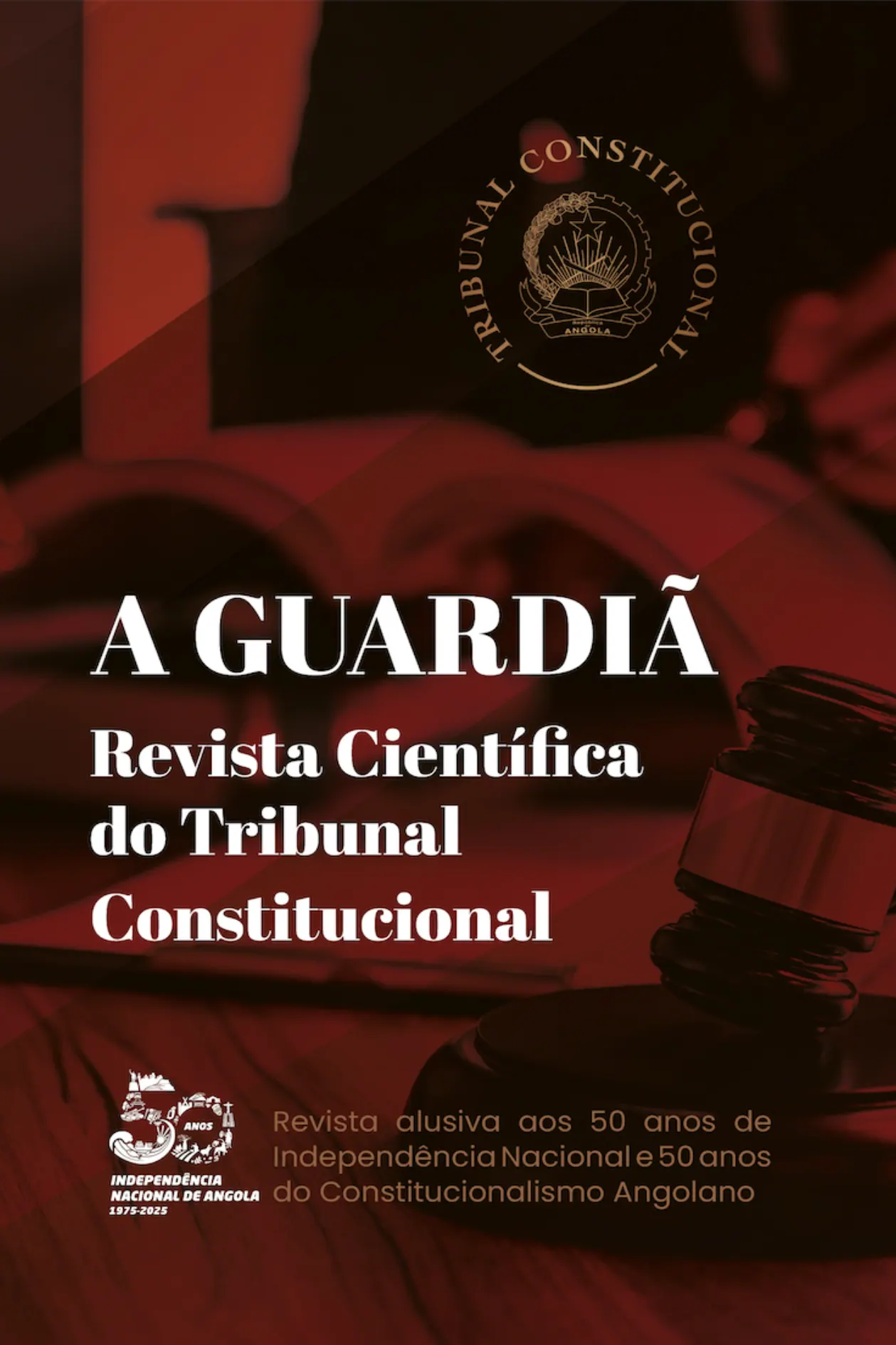
On 17 June 2025 the Constitutional Court celebrated 17 years since its establishment in 2008. To mark the occasion, the Court published and launched the 3rd edition of its academic journal “A Guardiã”, a compendium of more than 500 pages, produced with the aim of promoting knowledge of various matters of a legal and constitutional nature. Contributors to this edition, which brings together further articles of a technical and scientific nature, include distinguished Angolan and international jurists and academics, such as Carlos Burity da Silva, Carlos Feijó, Suslândia Silva, Fernando Oliveira, João Pinto, Jorge Bacelar Gouveia, Júlia Ferreira, Imaculada Melo, Adalberto Luacuti, Francisco Queiroz, Celmira Matana, Hermínio Rodrigues, Albano Macie, Luzia Sebastião and Onofre dos Santos.
Information Note
SECOND EDITION OF THE JOURNAL A GUARDIÃ
Launched in June 2024, on the occasion of the 16th anniversary of the establishment of the Constitutional Court.
Information Note
FIRST EDITION OF THE JOURNAL A GUARDIÃ
The Constitutional Court of the Republic of Angola is the supreme body of constitutional jurisdiction, whose ultimate purpose is to administer justice in legal and constitutional matters, in accordance with the Constitution and the law. The fulfilment of this aim is not embodied solely in the performance of acts of a judicial nature, that is, the judgments and orders handed down in the examination of the cases brought before the Constitutional Court. Today, in modern States, constitutional jurisdictions must fulfil their institutional purpose and mission, particularly as regards the protection of Fundamental Rights, Freedoms and Guarantees, not only in the exercise of the judicial function but also in other forms connected with it, with a view to strengthening the democratic State governed by the rule of law and to the effective realisation of the fundamental values of their respective Constitutions. This is not intended to entrench the theory of judicial activism, that is, the excessive intervention of the judiciary in matters which, under the Constitution, are the exclusive responsibility of the Executive, which in practice would amount to a violation of the principle of the separation of powers and interdependence of functions.
In saying this, we wish to reaffirm that, under the principle of judicial self-restraint, the Constitutional Court must, in its primary function, confine itself to deciding jurisdictional questions and deny the justiciability of political questions, so as to prevent constitutional review from being used to engage in politics, without, however, neglecting its social responsibility. The Constitutional Court, which has increasingly asserted itself as a Human Rights Court, must not be a mere passive actor, shut away in its “castle”, waiting for social conflicts before being called upon to respond to them. The Constitutional Court, without breaching its role as arbiter and in strict compliance with the principle of the separation of powers, must increasingly be an active actor, particularly as regards its social responsibility as a disseminator of the values and foundations of the Constitution.