
Translated from Portuguese. The Portuguese version prevails. Ler em português
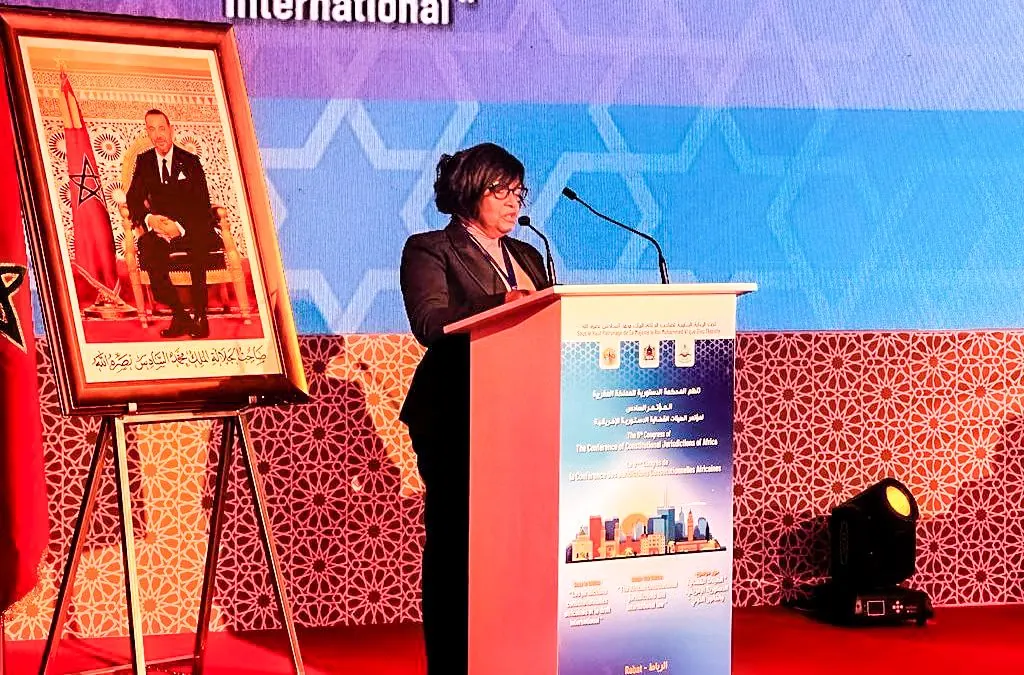
It is a profound pleasure for me to stand before Your Excellencies, and particularly at this 6th Congress of the Conference of Constitutional Jurisdictions of Africa (CJCA), an institution which the Constitutional Court of Angola has had the privilege of chairing for the past three years, and to speak on the status of international norms in the Constitution of my country. Since the earliest annals of Angola's history as an independent country, international law has formed an integral part of our legal order. It was enshrined and afforded constitutional protection from the very first Constitutional Law No. 1/75, which came into force on the date of the proclamation of our national independence, on 11 November 1975, when Angola established itself as an independent and sovereign State, and it was always upheld in the subsequent amendments, up to the approval of the Constitution of the Republic of Angola in 2010. As is often said, international law tends to regulate interests of a transnational or cross-border nature; it is something that transcends the sovereignty of a single State, but results from coordination among the various States. Today's international law is dynamic and flexible, but it does not depart from its classic concerns, aimed at regulating and governing conflicts and interests between States, international organisations or NGOs. Today, the place of international law in our legal order is grounded in the Constitution, in the part concerning fundamental principles (Article 13), which provides: “General or common international law, received under the terms of this Constitution, forms an integral part of the Angolan legal order.” In Angola, the sources of International Law invoked in the Constitution – and this applies by virtue of Article 12(1) – are the Charter of the United Nations and the Charter of the African Union. It should be stressed that, with regard to fundamental rights, the Universal Declaration of Human Rights and the African Charter on Human and Peoples' Rights are also invoked by virtue of Article 26. Our Lex Mater enshrines international treaties and agreements as sources of international law, provided that they have been duly approved or ratified, and they take effect in the legal order after their official publication and entry into force in the international legal order. It must be stated that the hierarchical position of constitutional norms in relation to other norms always places them in a position of supremacy, even in relation to norms of international law; it should be noted, however, that norms of international law, provided they are approved by Parliament, ratified by the President of the Republic and published in the official gazette, become part of our domestic legal order, in a hierarchical position immediately below constitutional norms and above ordinary norms. The Constitution of Angola does not draw a formal distinction between treaties and conventions and other international norms. Rather, it is ordinary law that gives substance to the notion of an international treaty as any agreement, whatever its particular designation – that is, whether treaties, agreements, conventions, statutes, charters or protocols; in other words, the designation "treaty" matters little, the only requirement being that it is a document of an international nature. Angolan law has as its primary source the Constitution, and these matters are consolidated in an ordinary law, namely the Law on International Treaties, which, for its part, classifies them as: solemn treaties, executive agreements and agreements in simplified form, distinguishing them by the body with competence to approve those legal instruments. Under our infra-constitutional law, solemn treaties require the signature of the President of the Republic, the Minister of External Relations or another duly mandated member of the Executive, and their entry into force in the domestic legal order is subject to prior consideration by the Council of Ministers, formal approval by the National Assembly and ratification or accession by the President of the Republic. It is also important to mention that solemn treaties deal with matters relating to: treaties on Angola's participation in international organisations, treaties establishing international organisations, treaties on the rectification of borders, treaties of friendship and cooperation, peace treaties, defence treaties and treaties concerning military matters, and treaties that entail changes to domestic legislation, in particular the status of persons and property, nationality agreements, consular agreements and the like. In light of the foregoing, in the Angolan legal system international treaties, although they have constitutional standing, do not enjoy immediate and direct applicability, under Article 13(2), read in conjunction with subparagraph (k) of Article 161 and subparagraph (c) of Article 121 of the Constitution. They are subject to approval in Plenary by the National Assembly by means of a Resolution, to ratification or accession by the President of the Republic and, finally, to publication in the Official Gazette (Diário da República). Furthermore, our Constitution establishes, among the political and legislative powers of our Parliament, that of approving for ratification and accession treaties, conventions, agreements and other international instruments dealing with matters within its legislative competence. Therefore, at the level of the Constitution, our Supreme Law, Parliament plays a decisive, crucial and unique role in the approval of international treaties. There is no other body with overlapping powers to approve these international instruments. Hence, Parliament is the legislative body par excellence that approves solemn treaties, and the President of the Republic has the sole power to ratify them. Other international Agreements (Executive agreements and agreements in simplified form), however, owing to the nature and importance of their subject matter, or because they do not lay down any legal formality after signature for their entry into force, fall within the competence of the President of the Republic, in the field of international relations, as Holder of Executive Power, and of the Minister of External Relations, respectively. In this regard, it also seems appropriate to mention that, under Angolan infra-constitutional law, Executive agreements are all those not covered by solemn treaties, and Agreements in simplified form are those dealing with exchanges of notes, notes verbales, navigation agreements and memoranda.
Excellencies! As already mentioned, the Constitution of the Republic of Angola is our Supreme Law, our Reference Law. It sets out the framework of structuring principles by which our country is organised and its functioning governed. With the enshrinement of constitutional norms on international relations and international law, several Resolutions were approved, formerly by the People's Assembly and nowadays by the National Assembly (our Parliament), which incorporated various treaties and conventions into our domestic legal order, notably:
1-Universal Declaration of Human Rights; – Adopted and proclaimed by the General Assembly of the United Nations (Resolution 217 A III) on 10 December 1948;
2-Resolution 15/84 of 19 September – Approves the accession of the People's Republic of Angola to the Convention on the Elimination of All Forms of Discrimination against Women;
3-Resolution No. 20/90 of 10 November – Approves for ratification the International Convention on the Rights of the Child;
4-Resolution No. 1/91 of 19 January – Approves the accession of the People's Republic of Angola to the African Charter on Human and Peoples' Rights, also known as the «Banjul Charter»;
5-Resolution No. 26-B/91 of 27 December – Approves, for accession, the International Covenant on Economic, Social and Cultural Rights and the International Covenant on Civil and Political Rights;
6-Resolution No. 25/00 of 1 December – Approves the accession of the Republic of Angola to the Rome Statute establishing the International Criminal Court;
7-Resolution No. 33/03 of 9 December – Approves for ratification the Protocol relating to the Establishment of the Peace and Security Council of the African Union;
8-Resolution No. 21/02 of 13 August – Approves the Optional Protocol to the Convention on the Rights of the Child on the Sale of Children, Child Prostitution and Child Pornography;
9-Resolution No. 23/07 of 23 June – Approves, for accession, the Optional Protocol to the United Nations Convention on the Elimination of All Forms of Discrimination against Women;
10-Resolution No. 25/07 of 16 July – Approves, for accession, the Protocol to the African Charter on Human and Peoples' Rights on the Rights of Women in Africa;
11-Resolution No. 2/13 of 11 January – Approves, for accession, the Optional Protocol to the Convention on the Rights of Persons with Disabilities, adopted in New York on 30 March 2007;
12-Resolution No. 11/13 of 11 April – Approves for ratification the African Union Convention for the Protection and Assistance of Internally Displaced Persons in Africa – Kampala Convention;
13-Resolution No. 38/16 of 12 August – Approves for accession the Convention on the Recognition and Enforcement of Foreign Arbitral Awards;
14-Resolution No. 50/18 of 31 December – Approves for accession by the Republic of Angola the Protocol of the Court of Justice of the African Union;
15-Resolution No. 4/19 of 18 February – Approves for ratification by the Republic of Angola the African Union Protocol on the Statute of the African Court of Justice and Human Rights;
16-Resolution No. 35/19 of 9 July – Approves for accession by the Republic of Angola the International Convention on the Elimination of All Forms of Racial Discrimination;
17-Resolution No. 37/19 of 9 July – Approves for accession by the Republic of Angola the Second Optional Protocol to the International Covenant on Civil and Political Rights, aiming at the Abolition of the Death Penalty;
18-Resolution No. 38/19 of 9 July – Approves for accession by the Republic of Angola the Convention against Torture and Other Cruel, Inhuman or Degrading Treatment or Punishment;
19-Resolution No. 3/20 of 2 January – Approves for ratification the African Charter on Democracy, Elections and Governance;
20-Resolution No. 14/22 of 7 April – Approves for ratification the Protocol to the African Charter on Human and Peoples' Rights on the Rights of Persons with Disabilities in Africa;
21-Resolution No. 15/22 of 7 April – Approves for ratification the Protocol to the African Charter on Human and Peoples' Rights on the Rights of Older Persons in Africa. As is evident, the Republic of Angola has acceded to and implemented many international instruments, and it is important to note here that the Constitutional Court of Angola, of which we are members, has been prolific in applying certain international instruments in cases of violation of the fundamental guarantees enshrined in, among others, the Universal Declaration of Human Rights, the African Charter on Human and Peoples' Rights and the International Covenant on Civil and Political Rights. It was also suggested to us that we give a brief account of the principle of the reserve of the possible (reserva do possível) in our Fundamental Law. On this point, we would first of all like to mention that, since its creation in Germany, the principle of the reserve of the possible has been taken up in many States with the aim of limiting demands made in favour of fundamental rights, always bearing in mind the financial component of the State, its possible adequacy and the necessity of the request made by citizens, according to a criterion of proportionality. The principle of the reserve of the possible is closely connected to the social State. There are social rights whose realisation is intrinsically linked to ordinary legislation approved by Parliament, as can be seen with the General State Budget, which sets out the financial forecast for each calendar year. The principle of the reserve of the possible can be inferred from the Constitution of the Republic of Angola in Article 28(2), which provides: “The State must adopt legislative initiatives and other appropriate measures for the progressive and effective realisation, in accordance with available resources, of economic, social and cultural rights”. The reserve of the possible denotes that the realisation of fundamental rights is conditional upon the availability of State financial resources to bear the costs of constitutionally enshrined rights. As the Angolan João Valeriano told us on the occasion of the celebration of the 12th anniversary of the Constitution of the Republic of Angola, “What stands out from the principle of the reserve of the possible is that social rights are enshrined in vague norms of indeterminate content, conceived and made positive law only through principles, so that their realisation always depends on the weighing, as ever, of opposing rules and principles, referring back to the budgetary choices of the legislator and, more specifically, to the clause of the reserve of the possible.” Similarly, he further states that “The reserve of the possible conditions, as an outer limit, the aspirations for social benefits, linking them to the financial capacity of the State, and, regardless of the financial resources available, the essential core of that right must be respected”. It cannot be overemphasised here that, in the field of fundamental rights, the Angolan Constitution provides in its Article 26 – transcribed here ipsis verbis for greater clarity – that “Constitutional and legal precepts relating to fundamental rights must be interpreted and integrated in harmony with the Universal Declaration of Human Rights, the African Charter on Human and Peoples' Rights”. Along these lines, whenever a dispute concerning fundamental rights arises, the Court must have recourse to international instruments such as the Universal Declaration of Human Rights and the African Charter on Human and Peoples' Rights. These are among the international instruments which our Constitution expressly states are to be applied by the Angolan Courts when hearing disputes on matters of fundamental rights, even if they are not invoked by the parties.
Blessings to you all!
Thank you very much for your attention!