
Translated from Portuguese. The Portuguese version prevails. Ler em português
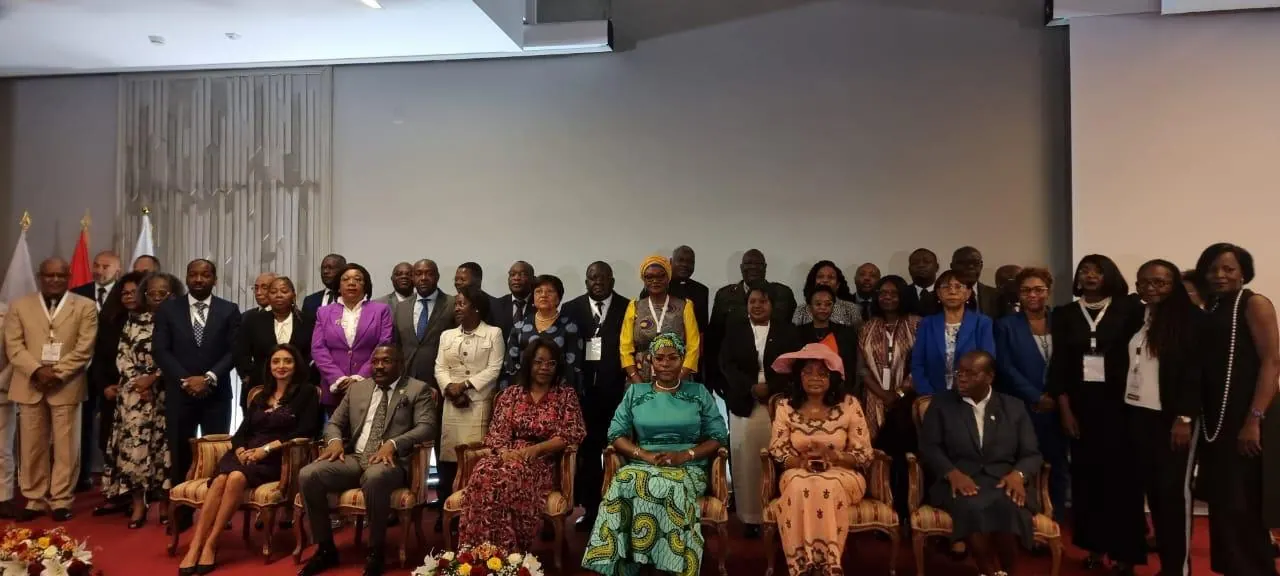
The Office of the Ombudsman (Provedoria de Justiça) held a conference on Wednesday, 13 December 2023, in the Auditorium of the Catholic University of Angola, in Luanda, to mark another anniversary of the Universal Declaration of Human Rights.
Invited to take part in the event, the President of the Constitutional Court, Justice Laurinda Prazeres Monteiro Cardoso, delivered the following address:
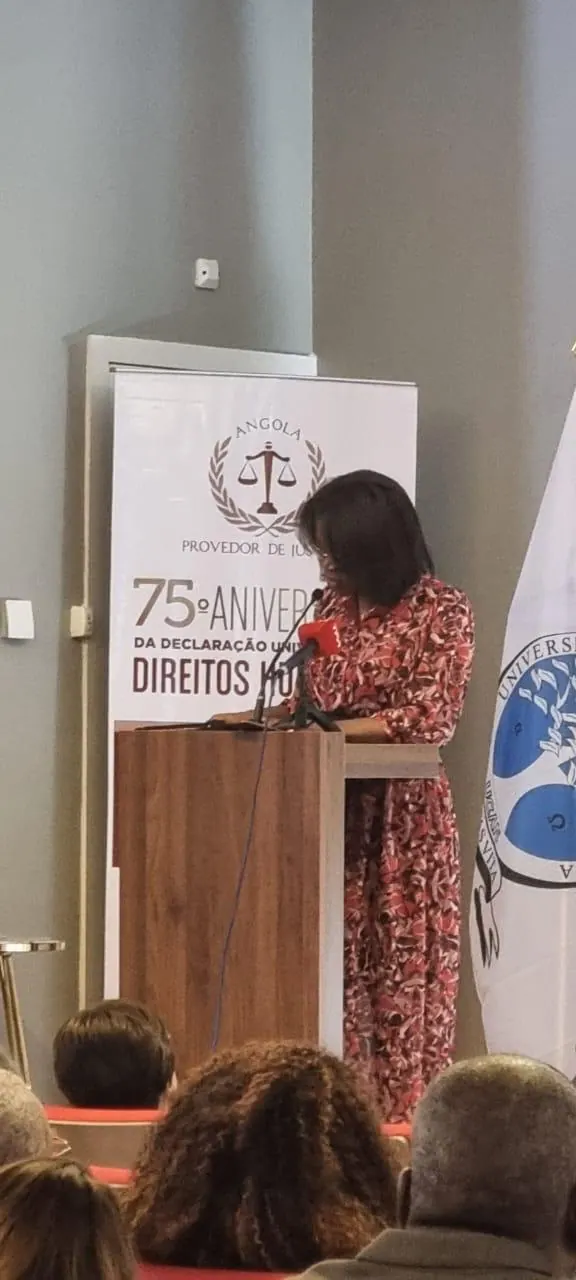
Ladies and Gentlemen, Distinguished Participants.
My thanks go to the Most Worthy Ombudsman for the invitation, and extend to all those who, directly or indirectly, spared no effort to enable us to promote, with such enthusiasm, the celebration of the 75th anniversary of the Universal Declaration of Human Rights.
Of the wide range of issues that could be addressed concerning the Universal Declaration of Human Rights, I have decided to bring to the fore the theme of the Universal Declaration of Human Rights and the rule of law, beginning by touching upon the content of this important legal instrument and its foundations, so as to be able to assess its implications for the principles and rules governing the rule of law, by which all States are bound.
From an analysis of this document, two basic premises worthy of note may be highlighted: the inalienable dignity of every member of the human family and the commitment to give effect to all the freedoms declared, without distinction or discrimination. Its articles are preceded by a preamble explaining the historical and social reasons that made its adoption necessary, and they set out the civil, political, economic, social and cultural rights of every individual.
The Republic of Angola was admitted to the United Nations Organisation (UN) on 1 December 1976, the date on which it signed and ratified the Universal Declaration of Human Rights. Since then, its contents have always been taken into account in Angolan constitutional history, beginning with the Constitutional Revision Law of 21 December 1976, through the Constitutional Laws of 1991 and 1992, up to the 2010 Constitution.
Angola's commitment to guaranteeing human rights did not stop at the ratification of the UDHR; the attention paid to international norms on such an important matter also extends to the African Charter on Human and Peoples' Rights, also known as the Banjul Charter, adopted on 27 June 1981 by the Organisation of African Unity (OAU) as an instrument counterpart to the European Convention and the Inter-American Convention on Human Rights, whose remit necessarily entails promoting human and peoples' rights and ensuring their protection on the African continent.
A democratic State based on the rule of law presupposes the convergence of the rule of law and democracy. Today, in a representative and pluralist democracy, the State cannot fail to be one based on the rule of law, as an imperative of legal rationality or functionality and of respect for people's rights. Political power belongs to the people and is exercised by the majority, but it is subordinate to the Constitution, with the consequent legal review of the acts of those in power (Articles 3, 4, 6 and 226, all of the CRA).
It is, therefore, with reference to this constitutional imperative that the Constitutional Court has always sought to fulfil its task as “guardian of the constitution” and, as the court of highest instance in legal and constitutional matters, has participated directly, through its case law, in the process of State decision-making at the highest level, because it interprets, in a binding manner, the norms designed to ensure the balance of the constitutionally guaranteed powers and thereby to restore social balance in the event of a violation on the part of an organ of the State.
From this perspective, there is a relationship between the Universal Declaration of Human Rights and the rule of law, both in the grounds that lay at its origin and in the content of its justifications.
The rule of law thus requires the realisation of the principle of the separation of powers and the guarantee of fundamental rights. However, the separation of powers is only possible in a representative democracy where there are special legislative, executive and judicial organs, each with independent, constitutionally guaranteed functions and powers.
Ladies and Gentlemen
In line with the premises referred to above, the Constitution of the Republic of Angola, like other African constitutions, recognises the Universal Declaration of Human Rights, the African Charter on Human and Peoples' Rights and the international treaties on the matter, by constitutional reference, and enshrines the open clause principle, by not excluding other fundamental rights contained in the laws and in the applicable rules of international law, and it categorises the provisions of the Universal Declaration of Human Rights as guiding principles in the interpretation of fundamental rights, under Article 26(2) of the CRA.
To conclude, I draw on the writings of Martín Kriele, according to whom “human rights establish conditions and limits for those who have the competence to create and amend the law, and deny the power to violate the law. Certainly, no rights can do anything against de facto power, the naked potestas, just as morality can do nothing in the face of cynicism. Rights only have effect vis-à-vis other rights, and human rights only in the face of a legal power, that is, in the face of a competence whose legal origin and legal status are respected by the holder of that competence.
This is the deeper reason why human rights can only function in a constitutional State. For the effectiveness of human rights, judicial independence is more important than the catalogue of fundamental rights contained in the Constitution”.
Thank you very much for your attention!
Luanda, 13 December 2023