
Translated from Portuguese. The Portuguese version prevails. Ler em português
His Excellency the President of the Republic, Dr João Manuel Gonçalves Lourenço;
Her Excellency the Vice-President of the Republic, Dr Esperança Maria Eduardo Francisco da Costa;
Her Excellency the President of the National Assembly, Dr Carolina Cerqueira;
Honourable Presidents of the Superior Courts;
Most Worthy Attorney General of the Republic;
Justices of the Superior Courts;
His Excellency the President of the Angolan Bar Association; Auxiliaries of the Holder of Executive Power;
Your Excellencies, Judges and Prosecutors;
Distinguished Guests;
Ladies and Gentlemen;
To you, dear child, here representing all Angolan children, a little kiss and congratulations on this day.
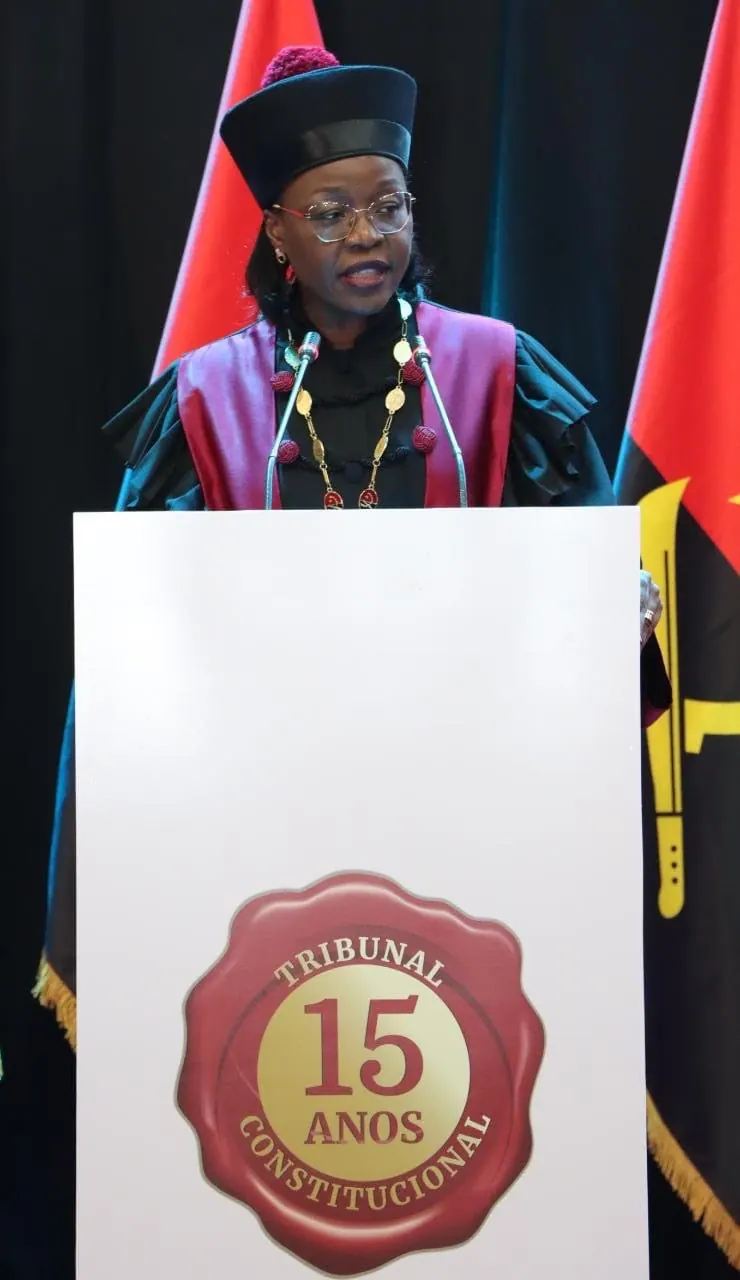
Welcome, all of you, to this grand Conference, which marks the beginning of the celebration of the 15th Anniversary of the Constitutional Court, a body of the Angolan State that was established on 17 June 2008 by Law No. 2/08 (Organic Law of the Constitutional Court), and which began its functions with the swearing-in of the first 7 (seven) Justices on the 25th of the same month and year.
15 YEARS have therefore elapsed since so noble an event.
And it is this anniversary that invites us to a focused reflection on the various transformations this Court has undergone, as a result of the dialectic and the dynamics inherent in its activity, as well as of the changes in our political and constitutional system.
I therefore avail myself of the privilege of addressing to Your Excellencies this message of welcome to this celebration, in order to share a brief overview of these 15 YEARS OF THE CONSTITUTIONAL COURT, structured around 3 (three) fundamental moments:
A FIRST MOMENT, RELATING TO ITS INSTITUTIONALISATION AND FUNCTIONING.
When the CONSTITUTIONAL COURT was institutionalised, in 2008, the appropriate dignity of its physical premises, befitting its importance as a constitutional body, was not ensured, although the basic and minimum conditions for its functioning were safeguarded.
Less than 2 (two) years into its existence, in 2010, the Justices of the CONSTITUTIONAL COURT carried out with distinction their task of prior review of the constitutionality of the 2010 Constitution, for the purposes of promulgation. This was an important milestone, which helped to increase the confidence of institutions, citizens and society in general in this Court, thereby strengthening confidence in the so-called primacy of the law within our democratic State based on the rule of law.
Until 2011, extraordinary appeals on grounds of unconstitutionality accounted for 57.8% of the caseload, while proceedings relating to political parties were in the order of 31.5%.
In 2012, already in the context of the preparations for the electoral process, the CONSTITUTIONAL COURT moved its seat to the Palace of Justice, that is, to these premises, where it remains to this day and where, as far as possible, together with the other institutions present here, the best working conditions and dignity have been ensured.
A SECOND MOMENT, RELATING TO QUANTITATIVE AND QUALITATIVE CHANGES.
From 2012 to the present day, now at the Palace of Justice, the CONSTITUTIONAL COURT has recorded exponential growth in its caseload, which has been accompanied by the expansion and training of its Human Capital, with a view to ensuring work that is of high quality, rigorous and consistent with the expectations surrounding this body.
As regards Human Capital, the CONSTITUTIONAL COURT came to have 11 Justices, with a consequent quantitative and qualitative increase in its Technical and Administrative Support staff.
This evolution is reflected in the 1,079 judicial cases registered to date, of which 1,012 (around 94%) have been concluded and 67 (around 6%) are pending.
Of the concluded cases, 824 were decided by judgment and 188 by order.
AND A THIRD MOMENT, RELATING TO THE NEED TO CONSOLIDATE THE CONSTITUTIONAL COURT AS A TRUE COURT OF FUNDAMENTAL RIGHTS.
The FIRST TWO MOMENTS represent the CHILDHOOD of this Institution. A phase in which the CONSTITUTIONAL COURT went through difficult times, such as organising and preparing the human, technical and logistical conditions to receive and validate the candidacies for the 2008 LEGISLATIVE ELECTIONS, as well as deciding the electoral dispute cases, at a time when it had practically just been born.
In the FIRST TWO MOMENTS, it also had to yield to the force of circumstances when, in 2010, the idea of exhausting the ordinary chain of appeals was introduced into the CONSTITUTIONAL PROCEDURE LAW.
In truth, this provision limits the role of the CONSTITUTIONAL COURT by restricting more direct access by citizens to constitutional justice, even where the violation of fundamental rights, freedoms and guarantees is at stake, in disharmony with the scope of Article 29 of the Constitution of the Republic of Angola, with particular emphasis on paragraph 5 thereof, which I quote:
“In defence of personal rights, freedoms and guarantees, the law shall provide citizens with judicial procedures characterised by speed and priority, so as to obtain effective and timely protection against threats to or violations of those rights.”
These experiences, through which the CONSTITUTIONAL COURT inevitably had to pass, were a kind of preparation for coming of age. With 15 YEARS OF EXISTENCE, the CONSTITUTIONAL COURT is
no longer exactly a child; it is already an emancipated adolescent, from whom serious and responsible work is required.
Today, it is our duty – and we are ready to fulfil it – to consolidate the exercise of the constitutional and legal powers of the CONSTITUTIONAL COURT AS A TRUE COURT THAT IS GUARDIAN OF THE CONSTITUTION AND OF FUNDAMENTAL RIGHTS.
These moments, which constitute genuine points of reference, remind us of the need always to keep alive and present the INSTITUTIONAL AND COLLECTIVE MEMORY OF THE CONSTITUTIONAL
COURT, since they reflect WHERE WE HAVE COME FROM, WHERE WE ARE and WHERE WE WANT TO GO.
It is also in our common memory that the strength, continuity and stability of this Institution reside, within a social and political context, functioning as part of it, but equally as its safeguard.
It is thus easy to see that the JUDICIAL FUNCTIONS of this Court cannot be dissociated from its ORGANISATIONAL CULTURE. Judicial proceedings are the very reason for our existence; and our organisational culture is the FOUNDATION FOR RESOLVING THEM BETTER, since in any Institution the starting point is people, whom we all swear to serve, but on whom we rely to perform this service with the utmost rigour and responsibility.
And, to conclude, allow us, from this podium, to extend a special greeting to the first President of the Constitutional Court, Dr Rui Ferreira, and to the Justices, women and men, who before us embraced the mission of performing such functions in this Court.
I also greet the Technical and Administrative Support Team, which is the mainstay of the proper functioning of this constitutional body, and which will be available over the coming days to welcome all citizens who wish to visit us to learn about the functioning, functions and powers of the Constitutional Court.
And I humbly bow in memory of Justice Dr Teresinha Lopes, a retired Justice of the Constitutional Court, appointed in 2012, who departed for eternity in 2019.
With this tribute, we express, in addition to our personal appreciation, our institutional gratitude for all that they have done and continue to do for our Constitutional Court.
THANK YOU VERY MUCH, AND BLESSINGS TO YOU ALL