
Translated from Portuguese. The Portuguese version prevails. Ler em português
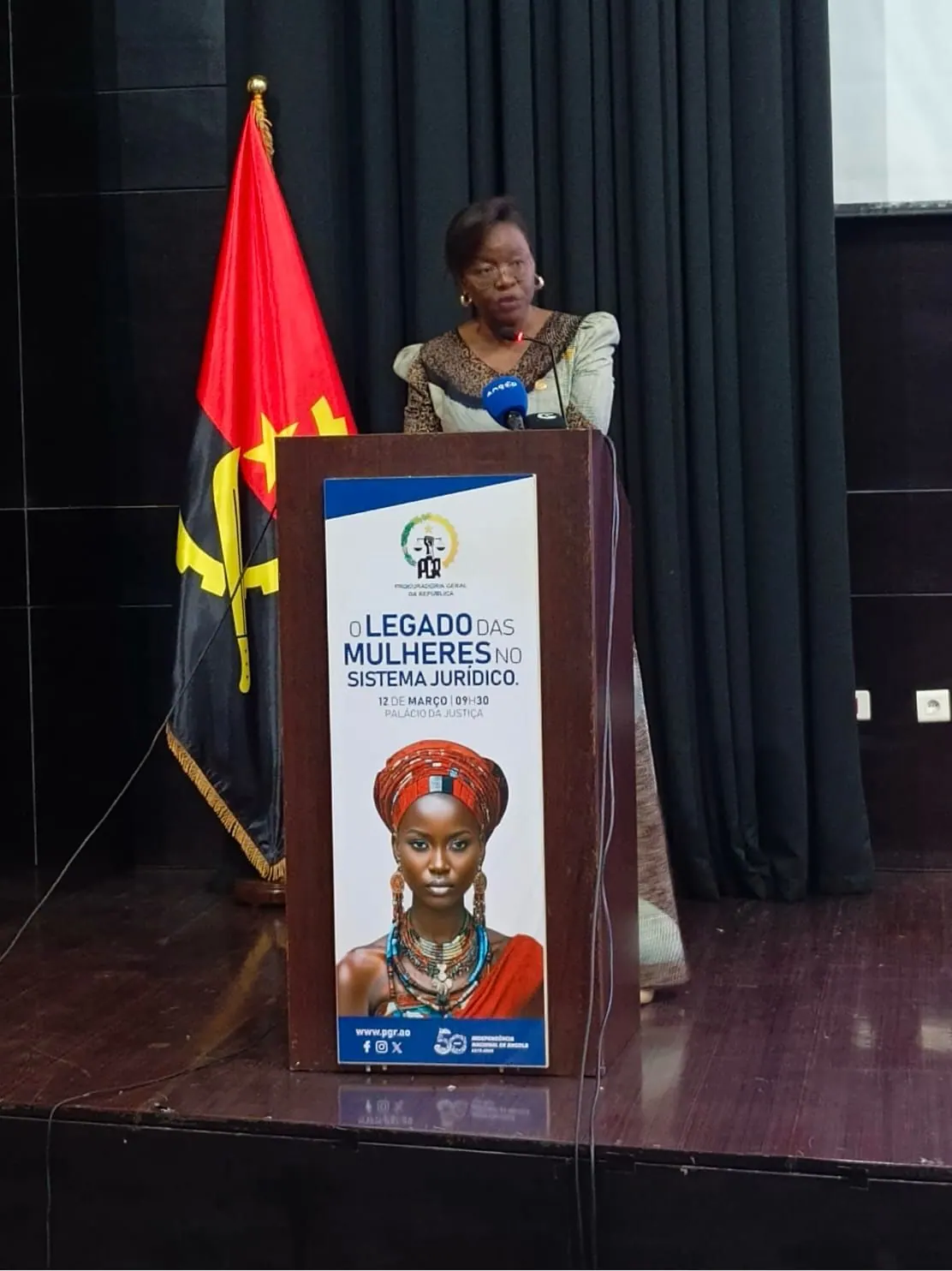
Within the framework of the Março Mulher (Women's March) activities and of the celebrations of the 50 Years of National Independence, the Attorney General's Office held, on Wednesday, 12 March 2025, the lecture “O Legado das Mulheres no Sistema Jurídico” (The Legacy of Women in the Legal System).
Read in full the address by the President of the Constitutional Court, Justice Laurinda Prazeres Monteiro Cardoso, which marked the opening of the event.
His Excellency the Attorney General of the Republic;
Honourable President of the Court of Auditors;
Honourable Justices of the Superior Courts;
Their Excellencies the Deputy Attorneys General of the Republic;
His Excellency the Minister of State and Head of the Civil Office of the President of the Republic;
Distinguished Magistrates, lawyers and academics;
Distinguished Guests;
Ladies and Gentlemen.
It is with immense honour that I accepted the invitation extended to me by the Most Worthy Attorney General of the Republic, Dr Hélder Fernando Pitta Gróz, to deliver the opening address, and I congratulate him at the outset on organising this event of paramount importance for the consolidation of the rule of law, since a truly just society is one in which men and women have the same opportunities to contribute to its functioning and development.
The topics scheduled for this event come under the motto “O legado da mulher no sistema Jurisdicional Angolano” (The Legacy of Women in the Angolan Judicial System), which presupposes, in my view, not only recognition of the progress achieved but also reflection on the challenges that still persist and the road that lies ahead of us in building a sound and inclusive judicial system.
The Angolan woman carries in her DNA the resilience of our ancestors, who resisted colonisation, fought for national independence and rebuilt the country. This ancestral strength is present in every meeting where her voice resounds, in every policy she implements and in every team she leads.
As far as the judicial function is concerned, our history records that the female presence in this sector was frequently limited, not for lack of ability, but because of social and institutional barriers that denied women the right to opportunities on an equal footing.
However, it is thanks to the resilience and tireless work of many women and men that women won the right to study, to practise law, to judge, and to interpret and apply the Constitution. Figures such as Myra Bradwell and Ruth Bader Ginsburg in the United States, Fatou Bensouda at the International Criminal Court and Maria do Carmo Medina (the first Angolan woman magistrate) demonstrated the greatness of women's participation.
The figures mentioned above not only opened doors for women to enter the judiciary, the legal profession and the prosecution service, but also redefined the concepts of justice and equity, demonstrating that justice is only complete when it is more inclusive and representative.
Nevertheless, the Angolan women who hold decision-making positions in the judicial system are true pioneers, whose daily work not only sustains the pillars of justice in the country but also opens paths for future generations. This legacy, built with determination and wisdom, is a living testimony to women's capacity to transform institutions and societies.
By way of example, in Angola, within the ordinary and special jurisdictions, the Superior Courts have the following records:
I. Constitutional Court: 5 women (45%), 6 men (55%);
II. Supreme Court: 8 women (38%), 13 men (62%);
III. Court of Auditors: 4 women (31%), 9 men (69%);
IV. Supreme Military Court: 0 women (0%), 7 men (100%).
A point worth highlighting from the female perspective: with the exception of the Supreme Military Court, the Vice-Presidency of the Superior Courts, and even of the Attorney General's Office (PGR), is held by women.
The role of Angolan women in the judicial system has deep roots going back to the struggle for independence. The Angolan Constitution of 2010 reinforced the principle of gender equality, allowing significant advances in women's participation in all spheres of power, including the judiciary.
Historically, the following milestones stand out:
I. The appointment of the first Angolan woman judge, Professor Dr Maria do Carmo Medina, who paved the way for other women in the judicial system after independence;
II. The first woman President of the Court of Auditors;
III. The first woman President of the Constitutional Court;
IV. The first women Vice-Presidents of the Superior Courts: the Constitutional Court, the Supreme Court and the Court of Auditors;
V. The first woman Deputy Attorney General of the Republic;
VI. The first woman President of a Court of Appeal.
In short, the gradual increase in the presence of women in the magistracies, both in the Public Prosecution Service and in the Judiciary, and in the superior courts, notably the Constitutional Court, where women have contributed to decisions fundamental to the democratic State based on the rule of law, demonstrates the strength of our struggle.
The emphasis we place on this here attests to our awareness that, in Angola, the female presence in the judicial system is not merely a recent achievement; it is a testimony to the dedication of generations of women who challenged stereotypes and won their place. From the pioneering women lawyers and magistrates who faced challenges in a post-independence context to the women magistrates who today hold prominent positions, the path has been trodden with determination and commitment to justice.
However, one cannot speak of the female legacy in justice without mentioning names such as Maria do Carmo Medina, a pioneer who helped to structure the Angolan legal system in the post-independence period, and so many others who, quietly behind the scenes of the courts, universities and advisory bodies, shaped and continue to shape justice in our country, to name but a few: Antonieta Coelho, Paulette Lopes, Luzia Sebastião, Terezinha Lopes, Ana Maria Azevedo Chaves, Eva Ferreira, Suzana Inglês, Elisa Rangel Nunes, Laurinda Jambela, Guilhermina Prata, Lizete Veríssimo da Costa, Marieth Oliveira and Isabel Repsina, Maria do Rosário Veloso, among many others, who, with dedication and commitment, built a legacy that makes us proud and inspires us to move forward.
Your Excellencies,
Ladies and gentlemen,
Dear Participants,
Today, women in the Angolan judicial system face various challenges, among them that of contributing to the modernisation of justice while preserving essential values:
Integrity and Ethics: we need to strengthen the mechanisms of exemplary commitment to impartiality and judicial ethics, qualities that are fundamental to guaranteeing public confidence in the justice system.
Social Sensitivity: The presence of women in the courts has brought a distinct perspective to cases involving family matters, the protection of minors and domestic violence, contributing to a great extent to the humanisation of the judicial system.
Efficiency and Dedication: Despite the structural challenges, women legal professionals can contribute significantly to implementing and improving case management and service to citizens.
Mentoring and Inspiration: Every woman in a leadership position in the judiciary serves as a role model for law students and young professionals, demonstrating that it is possible to break gender barriers in a field traditionally dominated by men.
Your Excellencies,
Dear Colleagues and Participants,
The horizon for women in the Angolan judicial system is promising, yet challenging. Consider, for instance, topics such as:
* Technological Innovation and Modernisation
The digitalisation of judicial proceedings and the implementation of new technologies represent an opportunity for women to lead the modernisation of the judicial system. Adapting to digital tools, artificial intelligence and modern management systems are areas where the female sensitivity to detail and the ability to implement change with empathy can make a difference.
* Protection of the Family as a Pillar of Society
Strengthening the family as the basic social unit remains a priority. Women in the judiciary have the unique opportunity to develop case law that protects the family unit while guaranteeing individual rights, especially those of children and adolescents.
* Inclusive and Accessible Justice
The future of the Angolan judicial system depends on its capacity to serve all citizens, regardless of their economic circumstances or geographical location. Women Magistrates can drive projects and actions involving other institutions with a view to promoting free legal aid programmes; simplifying legal procedures so that they are better understood by ordinary citizens; setting up mobile courts to reach remote communities; and developing legal education programmes to empower women and families.
* International Cooperation and Professional Development
The exchange of experience with the judicial systems of other countries, particularly those with greater female representation, can bring inspiration and new methodologies. Participation in international forums and continuing training are essential for professional and institutional growth.
And, before I conclude, taking advantage of the fact that we are in the month of March, in which we have a triad of celebrations, namely Angolan Women's Day, International Women's Day and the Day of Women Judges, allow me to offer here a few special reminders to Angolan women in general, and to women magistrates in particular:
Your daily work is not merely a career, but a living legacy that shapes the future of the nation. When you apply the law with wisdom and compassion, you are protecting not only individuals but entire families. When you innovate and modernise procedures, you are not only improving efficiency but making justice more accessible to all Angolans.
Women magistrates, advisers, lawyers and others, always remember:
* Your voice matters: Every decision, every opinion, every dissent has the power to shape the law and influence generations.
* Your example inspires: Young women observe your path and gain the courage to follow similar paths.
* Your wisdom transforms: The unique combination of legal knowledge and social sensitivity creates a more humane justice.
* Your balance guides: The ability to harmonise career, family and social responsibilities shows that it is possible to be fulfilled in every dimension of life.
Women in the Angolan judicial system are not merely applying laws; they are building a new paradigm of justice that combines legal rigour with the values of protection, care and social development. This is, in my view, a legacy of inestimable value for Angola and for the world.
To conclude…
The legacy of women in the Angolan judicial system is a mosaic under construction, in which each piece represents an achievement, a barrier overcome, a just decision. As more women take on leadership roles in the judiciary, the legal profession and other legal fields, this legacy grows stronger and expands.
The future of justice in Angola will be shaped by women's hands that combine strength and sensitivity, tradition and innovation, respect for the past and a vision of the future. This is an ever-evolving legacy, which honours the path travelled by the pioneers while opening new paths for the generations to come.
The true measure of this legacy lies not only in written laws or published decisions, but in the lives transformed, the families protected and the fairer society that emerges when women participate fully in the administration of justice.
Accordingly, I declare open the lecture on the theme: “O legado das Mulheres no sistema Jurisdicional” (The Legacy of Women in the Judicial System)
THANK YOU VERY MUCH FOR YOUR KIND ATTENTION.