
Translated from Portuguese. The Portuguese version prevails. Ler em português
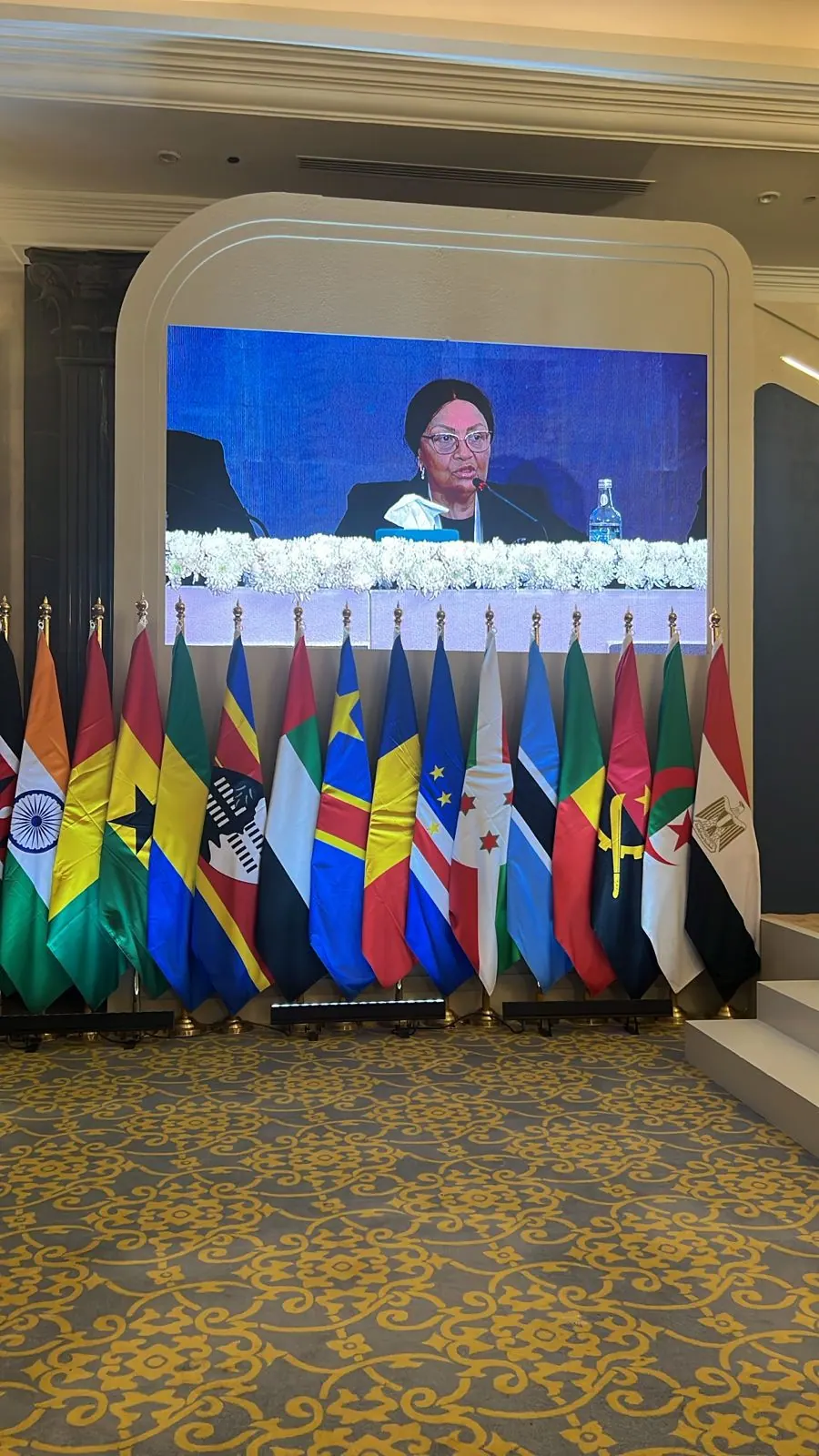
In her presentation, delivered on the morning of Saturday, 6 February, on the first panel of the event, devoted to the theme of the Independence of Constitutional Justice, Victória Izata spoke on the Independence of Constitutional Jurisdiction from the Angolan Perspective, as an essential element of the democratic State based on the rule of law.
During her address, she highlighted several aspects that make constitutional jurisdiction a pillar of democracy, namely guaranteeing the supremacy of the Constitution, protecting fundamental rights and checking the excesses of public authorities.
The address by the Vice-President of the Constitutional Court, in full.
“I would like to begin by thanking, on behalf of and representing the Honourable President of the Constitutional Court of Angola, Dr Laurinda Jacinto Prazeres, the distinguished Honourable President of the Supreme Constitutional Court of the Arab Republic of Egypt, Dr Boulos Fahmy Eskandar, for his kind invitation to our Court to take part in this important meeting.
I take this opportunity to express our deepest thanks to the Egyptian people and to the Supreme Constitutional Court of the Arab Republic of Egypt for the opportunity to visit once again a friendly country with which we have historical ties, and for the warm welcome and the excellent working and accommodation conditions provided in this beautiful, welcoming and historic city of Cairo.
Having made these remarks, let us now turn to the topic we were asked to address at this meeting: “The Independence of Constitutional Jurisdiction – The Angolan Perspective”.
Your Excellencies
Honourable Presidents of the Constitutional Courts, Supreme Courts and Constitutional Councils
Honourable Vice-Presidents and Honourable Justices of the Constitutional Courts, Supreme Courts and Constitutional Councils
Dear participants
Ladies
Gentlemen
It is with a great sense of responsibility and immense honour that I address this august assembly so that we may reflect on a topic that is fundamental to the consolidation of the rule of law in Africa: the Independence of Constitutional Jurisdiction, a topic I shall address from the perspective of the Angolan experience.
Constitutional Jurisdiction as a Pillar of Democracy
Excellencies,
Ladies and Gentlemen,
Constitutional jurisdiction is a pillar of democracy in that it ensures that the established powers respect the Constitution, defending fundamental rights and limiting those powers by reviewing the constitutionality of their acts and omissions; it acts as a counterweight to the elected powers, ensuring the primacy of the supreme law and protecting citizens against excesses, even if this causes some discomfort, and it is essential to a democratic State based on the rule of law.
In performing this function, constitutional jurisdiction acts as a mechanism for guaranteeing the supremacy of the Constitution, protecting citizens against possible excesses of power, even when such action may give rise to sensitive debates or to particularly demanding decisions. It is, therefore, a function that is indispensable to the consolidation of democracy and to strengthening citizens' trust in institutions.
In Angola, although the experience of constitutional jurisdiction goes back some five decades, the institutionalisation of the Constitutional Court took place relatively recently, some eighteen years ago. Even so, that milestone represented a significant advance in the country's constitutional history, contributing substantially to deepening the legal and constitutional awareness of Angolan citizens and of all those who have chosen Angola as a place for personal and professional fulfilment.
At the legal and constitutional level, the Constitution of the Republic of Angola enshrines, in Article 6, the structuring principle of constitutional supremacy, in the following terms:
-
The Constitution is the supreme law of the Republic of Angola.
-
The State shall be subject to the Constitution and shall be founded on legality, and shall respect and ensure respect for the law.
-
Laws, treaties and other acts of the State, of local government bodies and of public entities in general shall be valid only if they are in conformity with the Constitution.
This provision is not limited to a formal proclamation; it states clearly that no power — whether judicial, legislative or executive — stands above the Constitution.
The Angolan experience, especially that consolidated after the adoption of the 2010 Constitution, demonstrates unequivocally that constitutional jurisdiction is not a merely decorative element of the institutional system, but an indispensable structural requirement for the affirmation, consolidation and maturing of any democratic order that aspires to be effective and substantive.
-
Constitutional Foundations of Independence
-
A) Normative Guarantees
The Constitution of the Republic of Angola establishes solid guarantees regarding the independence of the Constitutional Court, notably in Article 181, by providing for a plural composition that reflects an institutional balance:
* Four judges appointed by the President of the Republic, including the President of the Court;
* Four judges elected by the National Assembly by a qualified two-thirds majority, including the Vice-President of the Court;
* Two judges elected by the Superior Council of the Judiciary;
* One judge appointed through a public competition.
This model aims to ensure diversity of institutional origin, promoting balance and democratic legitimacy.
Institutional Autonomy
The Constitution also recognises that the Constitutional Court enjoys administrative, financial and patrimonial autonomy, having its own budget entered in the General State Budget.
This autonomy must be understood as a practical and effective condition for the exercise of judicial independence. Experience shows that financial autonomy is an essential element in protecting the Court against external pressure, enabling it to perform its functions with serenity and institutional responsibility.
The integrity of the rule of law rests on a judiciary free from undue interference. The autonomous management of resources is thus a safeguard ensuring that judicial decisions are taken on the basis of the Constitution and the law, and are not conditioned by factors external to the judicial function.
This aspect has received special attention from our Court, since, as in other African countries, although our Constitutional Court is allocated its own funds entered in the General State Budget, their execution often remains dependent on the Executive through the ministerial department responsible for managing public finances. Nevertheless, progress has been made towards full financial autonomy.
III. Independence in Case Law: Relevant Examples
Excellencies,
Allow me to share some examples from the case law of the Constitutional Court of Angola that illustrate the effective exercise of its institutional independence.
- Judgment No. 688/2021 – Prior Review of the Constitutional Revision
In the context of the 2021 constitutional revision, a provision was adopted requiring the superior courts to send annual reports on their activities to the President of the Republic and the National Assembly.
The Constitutional Court declared that provision unconstitutional for violating the principle of the separation of powers, finding that such an obligation could compromise the functional independence and institutional autonomy of the courts.
Following that decision, the National Assembly complied with the Court's interpretation, removing the unconstitutional provision from the final text adopted.
- Judgment No. 845/2023 – Unconstitutionality of a Presidential Decree
In response to an application by the Angolan Bar Association, the Constitutional Court declared unconstitutional Presidential Decree No. 69/21, which provided for a scheme of financial contributions to bodies of the Administration of Justice based on recovered assets.
The decision was based, among other aspects, on the violation of the National Assembly's reserved legislative competence and of the principles of the independence and impartiality of the courts, considering that such a scheme could affect public confidence in the administration of justice.
The said instrument was thus removed from the legal order.
- Judgment No. 1056/2025 of 4 December – Partial Unconstitutionality of a Law
Certain provisions of the Law on Crimes of Vandalism of Public Property and Services – Law No. 13/24 of 29 August – were declared unconstitutional in response to applications by the political party UNITA and the Bar Association (OAA), notably for violating the principles of proportionality, criminal legality and necessity, under Articles 57, 1, 2, 23 and 65 of the Constitution of the Republic of Angola.
Main Aspects of the Decision and of the Law:
Decision of the Constitutional Court: The Court declared unconstitutional the articles that established excessive penalties (20 to 25 years) and were vaguely worded.
The Court found that the law imposed more severe punishment (20–25 years) than the Angolan Penal Code (1 to 6 years) for similar conduct endangering life or property of high value, infringing the requirement of minimal intervention of criminal law.
The decision reflects the Constitutional Court's understanding that the protection of public property must not override fundamental constitutional principles and the proportionality of penalties.
- Dimensions of the Independence of the Constitutional Court
Three essential dimensions of judicial independence can be identified from the Angolan experience:
- Institutional Independence
o Administrative and financial autonomy;
o Plural appointment process;
o Fixed terms of office and guaranteed irremovability.
- Functional Independence
o Freedom of decision;
o Absence of external instructions;
o Procedural guarantees specific to judges.
- Personal Independence
o Rigorous criteria of integrity and competence;
o Security in the exercise of office;
o Adequate remuneration.
- Good Practices from the Angolan Experience
The good practices include, in particular:
* Prior review of constitutionality;
* Subsequent abstract review, with broad standing;
* The possibility of declaring unconstitutionality by omission;
* The repristination effects of decisions;
* The mandatory publication of judgments;
* The extraordinary appeal on grounds of unconstitutionality.
- The Role of Regional Networks
This meeting is of special strategic importance. Cooperation between African Constitutional Courts strengthens institutional resilience, promotes the sharing of case law and contributes to building common standards of judicial independence on the continent.
Instruments such as the African Charter on Human and Peoples' Rights and the Lilongwe Principles must be continually given fresh impetus through practice and institutional dialogue.
VII. Conclusion:
Independence as a Collective Responsibility
Excellencies,
The independence of constitutional jurisdiction is not a privilege of the Justices, but a fundamental guarantee for citizens. It is on this independence that peoples' trust in the Constitution and in democratic institutions rests.
The Angolan experience shows that independence is realised in difficult decisions, in fidelity to the Constitution and in institutional responsibility.
Africa deserves constitutional courts that are benchmarks of integrity, legal conscience and effective protection of fundamental freedoms.
As laid down in Article 177(2) of the Constitution of the Republic of Angola, the decisions of the Constitutional Court are binding on all public and private entities, thus reaffirming the supremacy of the Constitution.
May we, in a spirit of cooperation and sharing, continue to strengthen African constitutional jurisdiction for the benefit of present and future generations!
Thank you very much for your attention.