
Translated from Portuguese. The Portuguese version prevails. Ler em português
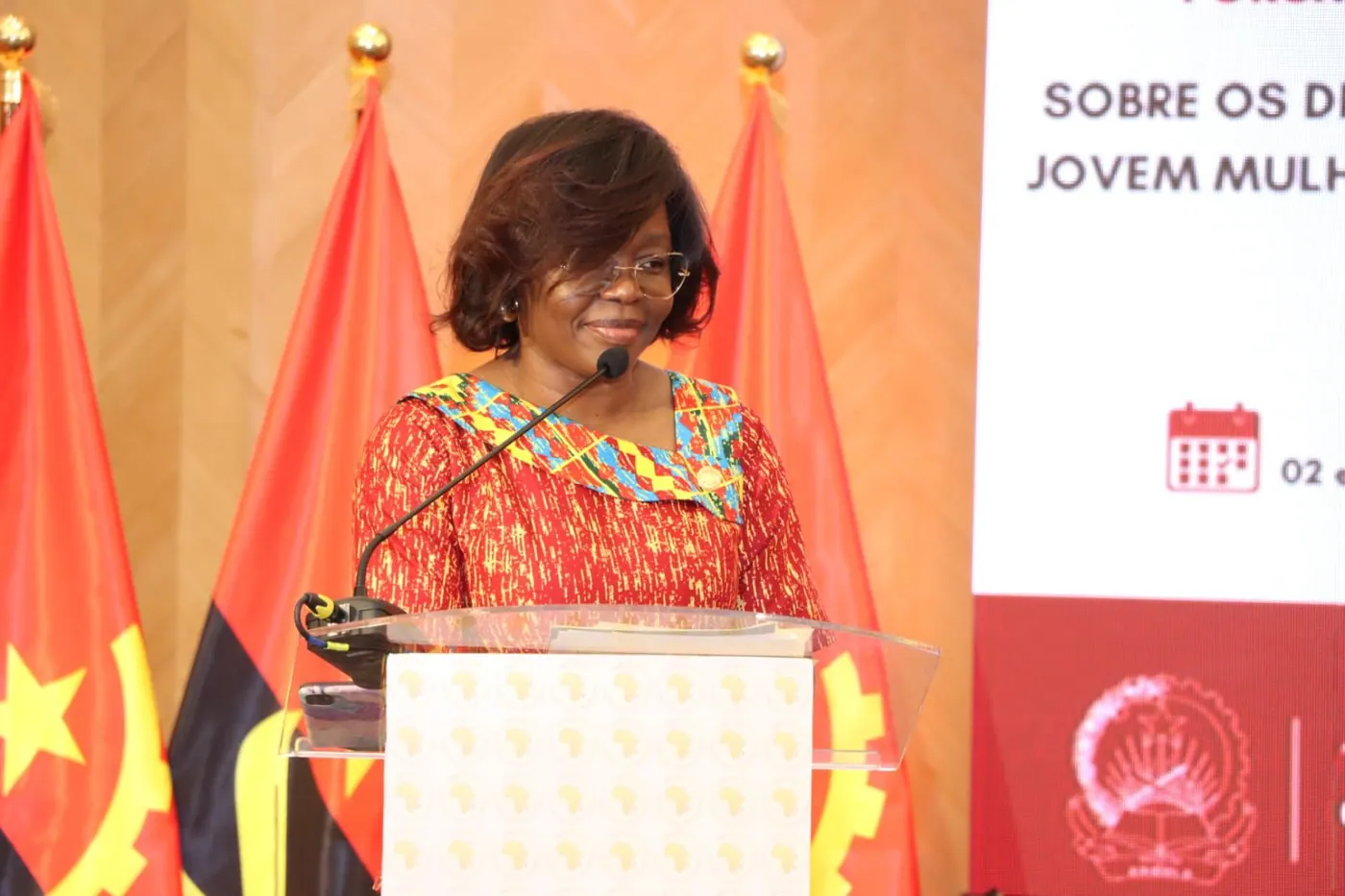
The opening address by the President of the Constitutional Court, Justice Laurinda Prazeres, in full.
Esteemed guests,
Ladies and Gentlemen.
“Let us imagine a 12-year-old girl who wakes before the sun rises, who stops going to school, who stops playing with other children in order to care for a newborn baby conceived in her own womb. She carries on her shoulders the frustrated hopes of an entire family, the anguish of social reproach for her misconduct, and is held responsible for her actions… and yet she keeps in her eyes the dream that tomorrow will be better...”
This girl exists. She is in Angola, she is in Senegal, in Nigeria, in Kenya, in Mozambique. She is in every corner of this continent that unites us.
Today, we are here for her and for all African children, and therefore, all protocol having already been observed, allow us to express a few words of thanks to all those who directly and indirectly contributed to making this event possible.
Our thanks to His Excellency the President of the Republic of Angola and President pro tempore of the African Union, represented here by His Excellency the Minister of State and Head of the Civil Affairs Office, Dr Dionísio Fonseca;
Our thanks to my fellow Presidents and Justices of the various Constitutional Jurisdictions;
Special thanks to the Executive Secretariat of the Conference of Constitutional Jurisdictions of Africa;
To UNDP, UNICEF and the African Union Committee, thank you very much for everything;
To His Excellency the former Vice-President of the Republic, who was also first Vice-President of the 1st Constitutional Commission of multiparty Angola, thank you very much for being here;
We are equally grateful for the presence of Her Excellency the Vice-President of the MPLA party, the Vice-President of UNITA, and the President of the Partido Humanista de Angola;
To the Justices of the Constitutional Court of Angola and the whole team, who selflessly gave their time to make this event possible;
To all the Young Women present here and those following us on the digital platform, Distinguished Guests and Participants, our heartfelt thanks, and please, all of you, be welcome to this Forum;
Excellencies, Distinguished colleagues, Dear Ladies and Gentlemen.
Sixteen years ago, Angola promulgated its Constitution of the Republic, and at the heart of this Magna Carta we inscribed a promise: that the State, the Family and Society — together — protect our children and young women against all forms of abandonment, discrimination and violence. This is what follows from Articles 80 and 81. It is, therefore, what our conscience demands.
This Forum is born of that promise, and of the recognition that a promise, however solemn, only comes to life when it is turned into action.
Our continent is rich. Rich in resources, in culture, in youth — the youngest in the world. But it is also a continent where millions of girls are prevented from studying. Where child marriage steals futures. Where female genital mutilation persists as an open wound in human dignity.
Excellencies, Ladies and Gentlemen
We would not wish merely to diagnose; the idea of institutionalising this forum is to reinforce the mechanisms that already exist by helping to create an open space for dialogue, the sharing of experience and reflection on the main problems afflicting young African women and children, so that, on the basis of its recommendations and conclusions, a transformative multisectoral agenda may be established that can help create a basis for implementing policies aimed at childhood and youth, with a view to improving the well-being of children and young women and, in this way, ensuring their sustained inclusion in society.
That is why this Forum brings together several forces which, separately, are important — but together are transformative: the knowledge of the constitutional courts, the picture of the Executive's actions, the diagnosis of the legislature, the commitment of international organisations, and the voice of civil society and of young people.
We would like to leave here not only with words; we would like to draft the Luanda Declaration — a high-level commitment. We want a mapping of African constitutional case law and concrete indicators to measure our progress. And we want, above all, a permanent network of cooperation between our jurisdictions.
The protection of fundamental rights is not merely an ethical or legal requirement; it is, indeed, a strategic imperative for the survival of our democracies.
Excellencies, Ladies and Gentlemen
To our most worthy fellow magistrates, we ask: let our courts not be sleeping guardians; let us be vigilant.
To legislators, we ask: transform the treaties we ratify into laws that are enforceable, prioritising in their essence the dignity of the human person from an African philosophical perspective — UBUNTU.
To the Executive, we ask that the principle of the “reserve of the possible” be invoked less and less in creating the conditions necessary to give effect to economic, social and cultural rights.
To civil society, we ask: do not rest; your voice is the alarm that does not let us forget.
And to young people — especially young women — we ask that you not wait for others to fight for you. You are not the future. You are the present, and the present demands active participation.
Let us return to the 12-year-old girl. She does not know that we are gathered here; moreover, she probably does not know that there are international treaties, conventions, constitutional articles, laws and State commitments written to protect her.
From the African Charter on Human and Peoples' Rights to the other regional and international instruments, namely the Protocol to the African Charter on Human and Peoples' Rights (Maputo Protocol), the Universal Declaration of Human Rights (UDHR), the International Covenant on Economic, Social and Cultural Rights (ICESCR), the 1979 United Nations Convention on the Elimination of All Forms of Discrimination against Women (CEDAW) and the Convention on the Rights of the Child (1989), we can see that the African regional (and international) normative architecture is densely provided with guarantees for the protection of Young Women and Children.
Nevertheless, there is an urgent need to resort to more coercive mechanisms aimed at making the normative provisions in force enforceable, and to reinforce the system with adequate legal procedures and responses capable of covering the main needs and vulnerabilities of this section of African society.
Our task is simple to state, yet difficult to fulfil: to ensure that every decision we take, every law we pass, every judgment we hand down reaches her, not as a promise, but as an effective right.
Excellencies, Ladies and Gentlemen,
“There can be no keener revelation of a society's soul than the way in which it treats its children.”
Madiba teaches us that caring for children is not merely a gesture of charity; it is, indeed, an ethical and collective responsibility, and therefore one that belongs to all of us.
Thank you very much.