
Translated from Portuguese. The Portuguese version prevails. Ler em português
Honourable President of the Constitutional Court, Your Excellency the First Vice-President of the National Assembly;
Honourable Presiding Justices of the Superior Courts, Honourable Justices of the Constitutional Court;
Distinguished Members of the Executive, Illustrious guests;
Ladies and gentlemen, Excellencies.
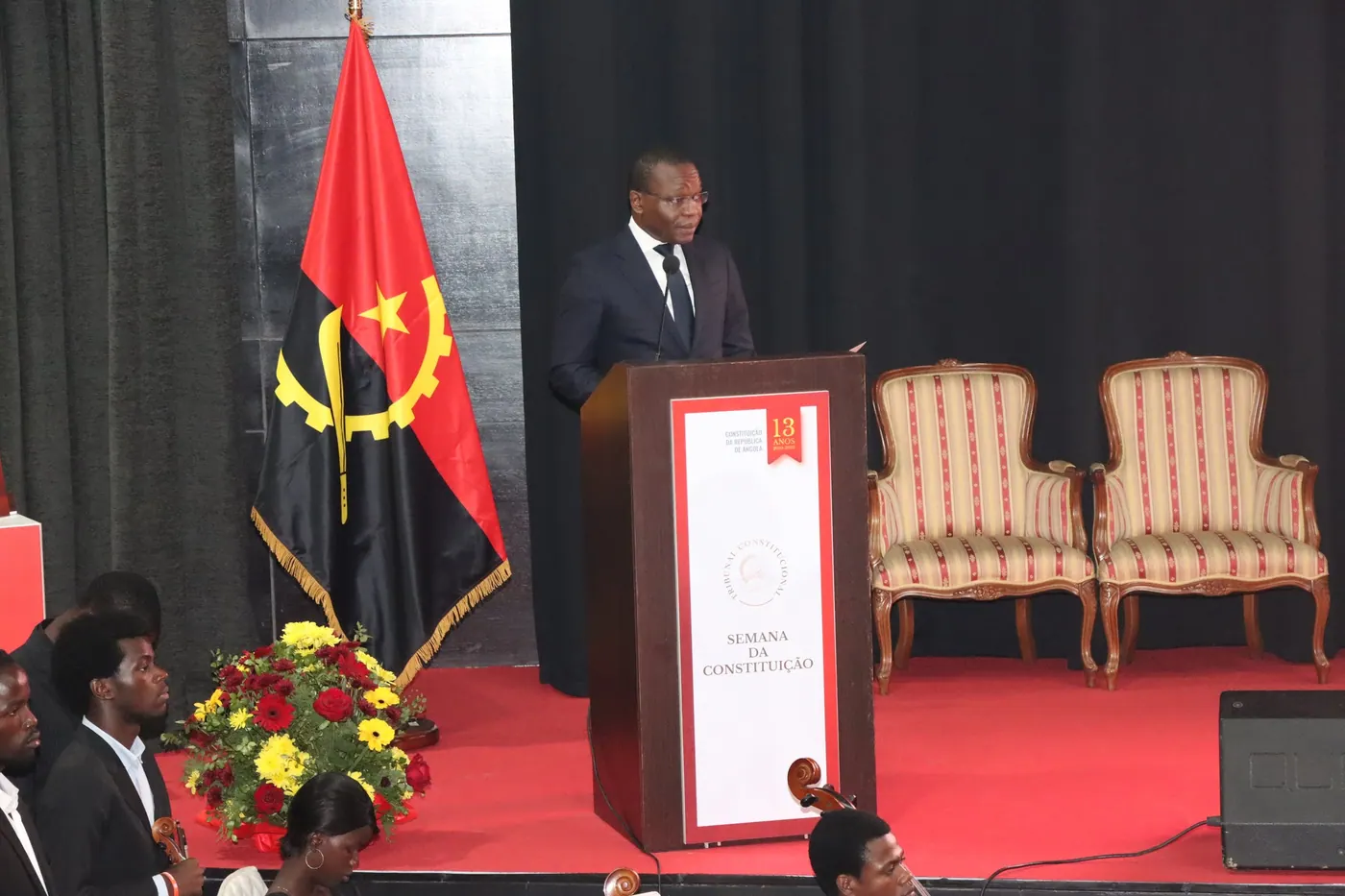
I convey to all present the cordial greetings of His Excellency JOÃO MANUEL GONÇALVES LOURENÇO, PRESIDENT OF THE REPUBLIC, whom I have the honour and the duty to represent here at this session marking the opening of the “semana da Constituição da República de Angola – 2023” (Constitution of the Republic of Angola Week – 2023), at a time when the date of the celebration of the 13th anniversary of our Constitution is approaching.
I greet, in particular, the Constitutional Court and congratulate it on the initiative of holding another series of days of reflection on our mother law and on the set of activities planned to disseminate our constitutional choices and to help citizens gain a better knowledge of our Constitution and, consequently, better exercise their rights and fulfil their duties.
Ladies and gentlemen.
Excellencies.
5 February 2010 witnessed the birth of a new Constitution and, with it, the renewal of our social contract, which unites and binds us before the same Homeland and impels us to work to bring about what is set out in Article 1 – in my opinion, the most important article of the Constitution of the Republic of Angola – according to which our fundamental objective is “the building of a free, just, democratic and solidary society, of peace, equality and social progress”.
On 5 February 2010, the Angolan people, through their legitimate representatives, decided to respect and reaffirm their history, their tradition and their culture, to affirm their choices sovereignly and to assume their commitment to the legacy for future generations.
At its birth, it was balanced in its solutions and bold in some of its choices. It understood the weaknesses of the past and was not afraid to seek innovative solutions. It did not ignore the experiences of other States, but it never gave up blazing a trail towards solutions designed for its own concrete reality.
At 13 years of age, it is a Constitution in the process of affirming itself. It could not be otherwise. It withstood the tests of birth and needs to withstand the tests of maturity. For it to be long-lived, as is advisable, the reasonableness of its postulates is not enough. Balance in its application is fundamental. This means recognising the crucial role of the Constitutional Court as guardian of the Constitution.
For it to have endured until now, the Constitution needed to be sufficiently programmatic, guiding and open in its fundamental principles, so as to give elasticity to the programmes for giving effect to them. For it to have come this far, it needed to be comprehensive and demanding in terms of fundamental rights, so that compliance with it would be rigorous, would promote the dignity of the human person and would be compatible with the idea of the rule of law. For it to have remained alive until now, boldness, balance and caution were needed in the organisation of political power and of the organs of the State, in order to foster a healthy institutional positioning and to ensure, unflinchingly, the essential functional stability. In these 13 years of life, as a result of a combination of various factors, the Constitution has been able to ensure the much-desired political stability, with no relevant situation of institutional instability attributable to it having been recorded. As I said, having withstood the tests of birth, the Constitution will now need to withstand the tests of maturity that the vicissitudes of the life of the State will place before it.
Distinguished participants
Excellencies
Without prejudice to the option of a provisional Constitution, typical of moments of transition in States, the objective of “longevity”, necessary for the idea of stability of the legal system, is intrinsic to the idea of a Constitution. So it is with our Constitution. However, it is not enough to aspire to a long life. Much more is needed in order to endure.
To withstand the tests of maturity and reach the desired stage of consolidation of its identity, the Constitution of the Republic of Angola, through those who apply it and those who guard it, must be capable of keeping pace with the most relevant social changes and with the evolution of the collective consciousness regarding its solutions. So that it does not stagnate in time and keeps pace with social dynamics, the Constitution requires creative judicial-constitutional solutions which, without ignoring its letter, are not confined to it, and which are inspired by the idea of law and by the need to build a free, just, democratic and solidary society, of peace, equality and social progress, as defined in Article 1.
Keeping pace with the evolution of the collective consciousness and with social changes requires the Constitution to be dynamic, capable of adapting itself permanently.
However broad its original legitimacy may be, the Constitution allows itself to be “delegitimised” if its solutions stagnate in time, if it becomes detached from the context of the reality it regulates and if it distances itself from those to whom it is addressed. This was the reason that justified the initiative for constitutional revision exercised by the PRESIDENT OF THE REPUBLIC in 2021, 11 years after our mother law came into force. With the constitutional revision approved by Law No. 18/21 of 16 August, among other advances, the catalogue of fundamental rights was broadened through the enshrinement of the right to vote for Angolan citizens residing abroad; the mechanisms for political oversight of the Executive by the National Assembly were clarified, conferring greater stability, security and predictability on the institutional relationship between the two organs of sovereignty; and the autonomy of the National Bank of Angola was extended, characterising it as a genuine independent administrative entity.
With this constitutional revision, dynamism was conferred on the 2010 Constitution, keeping it alive and increasing its potential for legitimacy. Without dynamism, the Constitution runs the risk of being overtaken and, consequently, of becoming a merely semantic instrument, without any relevance to the life of the community.
In order to achieve the longevity to which it aspires, and for this to be an active longevity, the Constitution needs to be truly normative, with a high potential for observance, and needs to establish a relationship of affinity with citizens.
On the other hand, in the opposite sense, longevity demands stability. One does not change Constitutions every day, nor does one change the Constitution every day. This is imposed by the need for stability, the desire for predictability and the belief in legal certainty and security of any political community.
It is not for nothing that our Constitution establishes, for ordinary revisions, an interval of at least 5 years between one and the next.
Therefore, as in many areas of life, the future of the Constitution depends greatly on our capacity, as those who apply its norms and those to whom they are addressed, to find balance. Between boldness and deliberation, between dynamism and stability, and between the will to be and the capacity to be.
Dialogue between the citizen and the Constitution is an essential element for the survival of the Constitution. The Constitution must not distance itself from the citizen, nor the citizen from the Constitution. Because the Constitution exists for the citizen. Because the citizen needs the Constitution. Because there is no Constitution without the citizen.
We must therefore permanently build full active citizenship, giving citizens access to the Constitution, to a correct knowledge of the Constitution and to the various mechanisms for the correct application of the Constitution. The correct application of the Constitution requires, as a starting point, the idea of a balance between rights and duties.
The idea of a Constitution that deifies rights and demonises duties is not correct. Not least because, if there are no duties, there will be little room for rights. Underlying the adage that “your freedom ends where mine begins” is the idea of correspondence between right and duty and of the importance of there being duties for there to be rights.
It is therefore fair and timely that we recognise here and now the importance of activities such as the “semana da Constituição” promoted by the Constitutional Court. Investing in citizens' constitutional literacy is investing in the relationship of sympathy between the citizen and the Constitution, an important requirement for finding the ideal point between the Constitution and constitutional reality. And this must happen from an early age and must make use of all appropriate instruments.
Here, too, it seems pertinent to commend the initiatives to produce the “Constituição infantil” (Children's Constitution) and to translate the Constitution into different national languages. Familiarising children from an early age with the main instrument for organising the society in which they live is, in itself, a right that children have. It is to ensure the “right to the future”. The future of children, the future of the Constitution and the future of the State.
Just as taking good care of children is preparing a better future for the Nation, teaching the Constitution to children from an early age is preparing a better future for the Constitution.
Illustrious participants, Excellencies.
The “Semana da Constituição da República de Angola – 2023” will be dedicated to the promotion and protection of the rights of the child in our Constitution – to our constitutional law of the child.
The constitutional choices regarding the protection of the child are clear, comprehensive, assertive and programmatic. A careful reading of the Constitution leaves no doubt as to the existence of a “constitutional concern” for the child.
First, the Constitution devotes Article 80 exclusively to the child. It enshrines:
• The right to special attention from the family, society and the State, which must ensure the child's protection against all forms of abandonment, discrimination, oppression, exploitation and abusive exercise of authority;
• The principle of the best interests of the child as a means of guaranteeing the child's full physical, mental and cultural development;
• Special protection for children who are orphaned, have disabilities, are abandoned or are deprived of a normal family environment;
• The obligation of the State to regulate the adoption of children; and
• The prohibition of the employment of minors of school age.
Furthermore, in other provisions, the protection of the child has been given a prominent place, namely:
• The obligation of the State to promote measures to ensure the “right to assistance in childhood”, provided for in Article 77(1);
• The protection of the rights of the child, namely their comprehensive and harmonious education and the protection of their health, among others, as an absolute priority of the family, the State and society, provided for in Article 35(6);
• The inclusion, among the fundamental tasks of the State, of the obligation to promote policies ensuring universal access to free compulsory education (with children implicitly as its main addressees), provided for in subparagraph (g) of Article 21;
• The obligation of the State to make strategic investments in human capital, with emphasis on the integral development of the child, provided for in subparagraph (i) of Article 21; and
• The presumption that a newborn found on national territory is an Angolan citizen by origin, provided for in Article 9(3).
The above statement leaves no doubt about at least two aspects: first, about the Constitution's interest in protecting the child as a strategic asset essential to the future of the country; and second, about the constitutional vision of the importance of families and society in giving effect to various rights of children. Indeed, the role of the family in safeguarding the constitutional rights of the child is fundamental and difficult to replace.
However, the constitutionalisation of the rights of the child is important but may prove insufficient if it is not accompanied by action to give effect to them. The success of this objective depends greatly on coordinated and integrated action by the family, the State and society, as indeed the Constitution states.
So that the rights of the child set out in the Magna Carta do not remain a dead letter, the Executive has drawn up and implemented public policies aimed at children, focusing on their integral development. Although this is not the appropriate forum for an exhaustive account, I cannot fail to mention some aspects that I consider essential to giving effect to our constitutional law of the child.
The importance of the issue can be gauged, first of all, from an analysis of the age pyramid in Angola. According to data from the National Institute of Statistics, of the approximately 33 million inhabitants, around 51% are children.
Thus, in order to ensure that effect is given to the constitutional postulate and to various international legal instruments in force in the Republic of Angola, Law No. 25/12 of 22 August on the Protection and Integral Development of the Child was approved.
Likewise, in order to ensure the comprehensive protection of the child and safeguard their healthy growth and development, the “11 Commitments for Children” were approved, which define a set of essential tasks that must be carried out on behalf of children. The “11 Commitments” cover the full range of children's rights, including civil rights and freedoms, the family environment, alternative care, basic care, health, well-being, education, leisure, cultural activities and social and criminal protection measures.
In the last legislature, within the framework of the implementation of the National Development Plan 2018-2022, the “Programme for the Protection and Promotion of the Rights of the Child” was implemented, which made it possible to achieve, among others, the following results:
• Placement of child victims of violence in reception centres and foster families;
• Creation of mechanisms to allocate financial resources to children and families through cash transfers, under the Programme to Combat Poverty and the Kwenda Programme;
• Mass civil registration at birth, with a view to guaranteeing the right to registration at birth;
• More than 230,000 children enrolled in the pre-primary initiation class (classe de iniciação);
• Reduction of the mortality rate at birth to 187 per hundred thousand registered live births;
• Increase in the vaccination coverage rate for children;
• Reduction of mother-to-child transmission of HIV by 15%.
In line with the recommendations of the International Labour Organization, the Executive approved the National Action Plan for the Eradication of Child Labour as a means of preventing, combating and eradicating child labour. In the same vein, the list of work prohibited or restricted for minors was recently approved by Presidential Decree No. 285/22 of 5 December.
The data presented seem to leave no doubt as to two conclusions: first, children constitute an important segment of society, to which the Executive has devoted particular attention. Second, not everything has been done. There is still much to do for the objectives to which we aspire in the field of child protection to be achieved.
Equally unequivocal is the conclusion that investing in children is preparing a better future for all.
Distinguished guests,
Excellencies
I conclude by thanking you, on behalf of His Excellency THE PRESIDENT OF THE REPUBLIC, for the invitation extended to him, and by expressing my wishes for a productive series of days in this “semana da Constituição” dedicated to the Constitution and to Children.
May the future smile on both.
Thank you very much!