
Translated from Portuguese. The Portuguese version prevails. Ler em português
Your Excellency the Provincial Governor;
Ladies;
Gentlemen;
Distinguished Participants.
My first words are, as they could not fail to be, words of gratitude. Thank you all very much for yesterday's warm welcome and for all the support provided in accommodating the members of our Court and the team accompanying us... we were able to feel the pulse and the strong vibrations of our Heart.
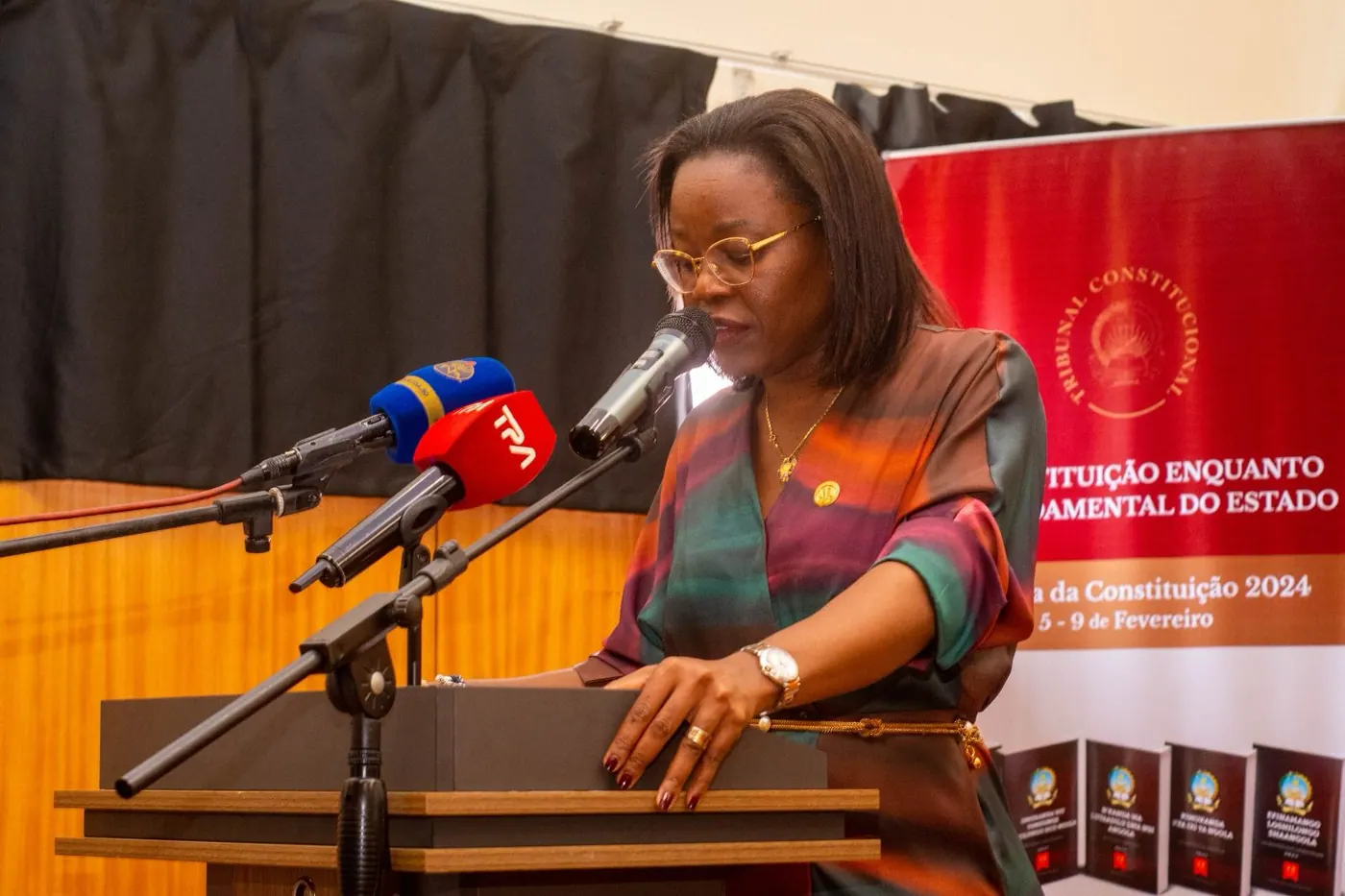
My renewed thanks to His Excellency the Governor, extended to all those who, directly or indirectly, spared no effort so that we could hold an exuberant celebration of the 14th anniversary of the promulgation of our Constitution, the Constitution of the Republic of Angola.
The adoption of a Constitution always represents the highest point in the political evolution of any State. It is, in the words of Political Science, the highest expression of Sovereignty.
The Constitution of the Republic of Angola, which today, 5 February, marks 14 years since its promulgation, represents the culmination of the political and constitutional transition process that began in 1991 with the adoption by the People's Assembly of Law No. 12/91, which enshrined the multiparty system, the guarantees of citizens' fundamental rights and freedoms and, therefore, the democratic political regime. The realisation of this set of constitutionally enshrined values must continue to be strengthened through acts of citizenship by all members of society and, precisely because it involves so many people, it is essential that each person feels part of it and finds their own time and space in which to act.
Throughout its existence, the Constitutional Court has been asserting its role of administering justice in matters of a legal and constitutional nature and, consequently, as guardian of fundamental rights, freedoms and guarantees, from an especially jurisdictional standpoint.
It is our conviction that the mechanisms for protecting fundamental rights, freedoms and guarantees must increasingly take on a social and participatory character, so that, among society and those to whom they are addressed, they may be approached in a simple and educational manner, thereby raising literacy about the Constitution of the Republic.
Excellencies, Distinguished Participants,
The debate on the various subjects that the Constitution embraces is perennial and continuous, and calls for the introduction of other, new variables of rationality; hence the need for us to resist the temptation of almost always reducing debates to an exclusively technical and bureaucratic perspective, which not infrequently makes them incomprehensible to citizens.
Making the Constitution an important instrument of national unity, a channel of communication and of frank and functional dialogue between the institutions and the society in which they operate, without marginalising anyone, is also a challenge of our times, since the Constitution is, first and foremost, a project for society, which defines all its aspirations, whether political, economic, social, cultural, environmental or of any other kind, provided that they are supported or guaranteed by the principles of the rule of law.
When understood by all, the Constitution becomes a unifying cultural element, promoting national cohesion and identity. It defines the rights and duties of citizens, helping to form a common basis of understanding and mutual respect among the various communities that make up the ethnic and linguistic mosaic of the State.
Consequently, the Constitution of the Republic of Angola reflects the history, values and aspirations of the PEOPLE, consolidating fundamental cultural and social elements. In a context of social change and technological progress, young people must be aware of the importance of the Constitution. It is absolutely crucial that young people know the Constitution, as it serves as the fundamental legal framework of the State.
Understanding their rights and obligations empowers young people to participate actively in society and, consequently, promotes informed citizenship, respect for the law, the defence of individual rights, and the protection of the collective good and of the public good.
Furthermore, knowledge of constitutional values contributes to the formation of a critical awareness and to the strengthening of the democratic political regime, preparing young people to engage constructively in social life.
For all these reasons, it is essential to disseminate the CONSTITUTION OF THE REPUBLIC more widely and more effectively, so that the most basic rights of each and every one are respected, in such a way that strict compliance with and respect for the Constitution are TRULY the matrix of the conduct of citizens and of the whole of Angolan society.
Excellencies, Distinguished Participants,
I conclude my address by reiterating my thanks to ALL the people of Bié from Cuito, Cuemba, Catabola, Chinguar, Andulo, Chitembo, Camacupa, Cunhinga and Nharea, represented here by His Excellency the Governor, Eng. Pereira Alfredo, and by wishing every success to the activities that bring to a close the celebration of the 14th anniversary of the Constitution of the Republic of Angola.
BLESSINGS TO YOU ALL. THANK YOU VERY MUCH FOR YOUR ATTENTION
Cuito, 5 February 2024.