
Translated from Portuguese. The Portuguese version prevails. Ler em português
Luanda, 19 June 2024.
Representative of the National Assembly, Dr Rosa Branca;
Representative of the Supreme Court, the Honourable Vice-President, Justice Efigênia Clemente;
Most Distinguished Attorney General of the Republic;
Distinguished Ombudsman;
Members of the National Assembly;
Judges and Magistrates of the Public Prosecution Service;
President (Bastonário) of the Angolan Bar Association;
Members of the Executive;
Professors and Academics;
Members of Civil Society.
Welcome, all of you, to this Ceremony celebrating yet another anniversary of the Guardian of the Republic's Magna Carta. Our thanks for your presence, so that we may solemnly mark here the 16 years of effective operation of the Constitutional Court.
It has become customary to make June the month of the Constitutional Court, celebrating the anniversary of its institutionalisation, the milestone of which is the entry into force of Law No. 2/08 – Organic Law of the Constitutional Court – and of Law No. 2/08 – Constitutional Procedure Law –, both of 17 June.
After 16 years of effective operation, the Constitutional Court has increasingly asserted itself as a Guardian of constitutional values and of the defence of Fundamental Rights, Freedoms and Guarantees, thereby strengthening the foundations of the Democratic State based on the Rule of Law.
However, in these complex and demanding times, we have an obligation to continue to innovate, giving the mechanisms for the protection of fundamental rights, freedoms and guarantees a social, participatory and inclusive character, so that, within society and among those to whom they are addressed, they may be approached in a simple and educational manner.
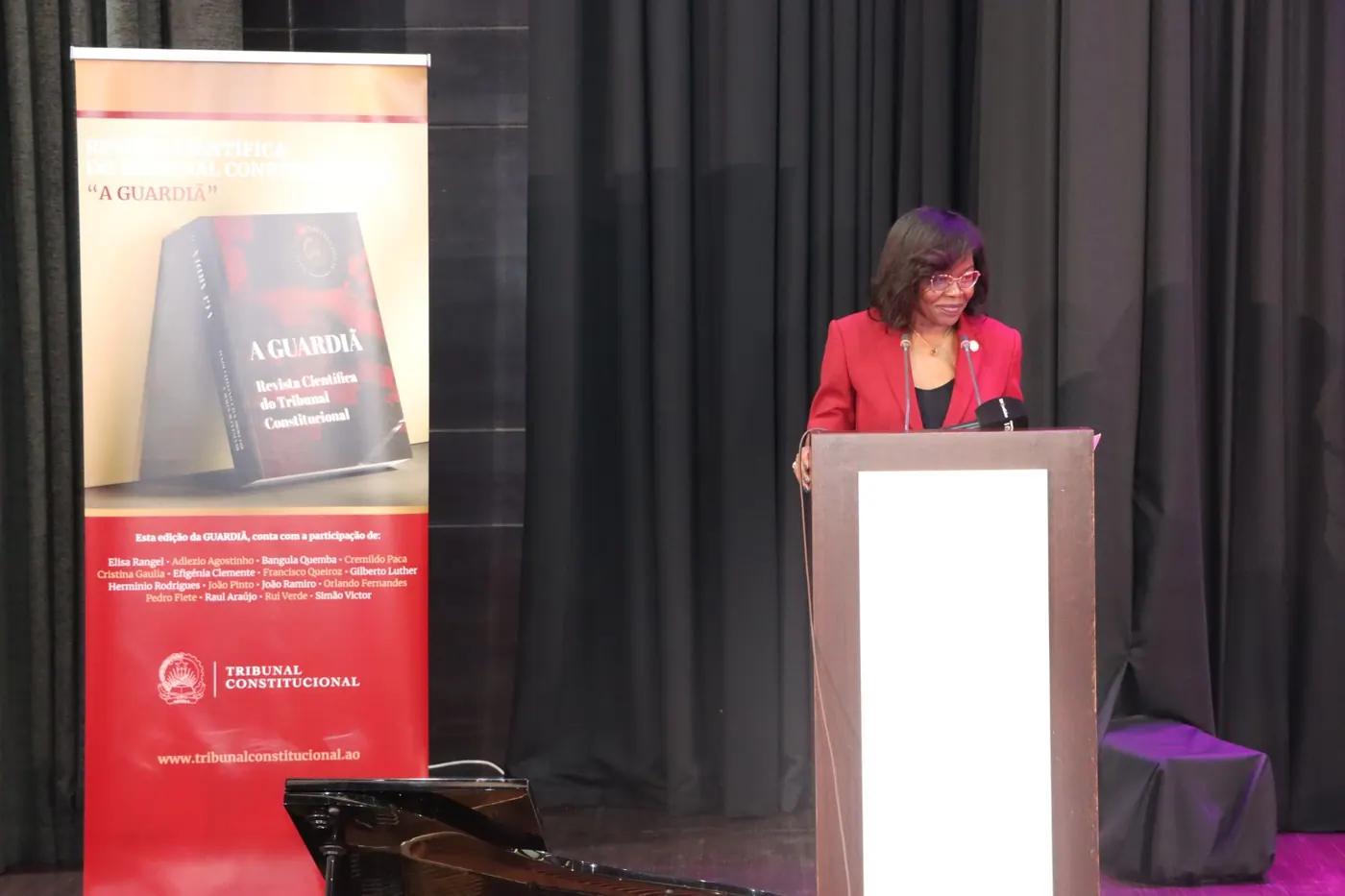
Imbued with this spirit, the Constitutional Court has under way Projects aimed at strengthening Constitutional literacy, including, among others, its academic journal, “A Guardiã”, the 2nd Edition of which we are presenting at this ceremony.
Conscious that the “general responsibility” entrusted to the Constitutional Court of ensuring the administration of “justice in legal and constitutional matters” also carries a proactive vocation to broaden knowledge and practice of, and about, the intangible legal and constitutional heritage of Angola. In other words, the Constitutional Court, in pursuing its remit, must accordingly guarantee the maximum effectiveness of fundamental constitutional values, the promotion, dissemination and teaching of case law and of Constitutional science being one of the important mechanisms for achieving that aim.
“A Guardiã”, whose 2nd Edition we are presenting today, stands as a privileged space for scientific, technical and academic reflection, which enables us to produce other and new variables of rationality and to build bridges with society and the Academy, bringing the Law to its practitioners, and beyond, thereby raising legal culture on constitutional questions and related matters.
We believe that, nowadays, we must resist the temptation to place the institutions of justice in a separate environment, as if they were not part of society and were not, likewise, both its product and its producer.
It is increasingly necessary to bring people closer, first, to the Law, before bringing them closer to the courts. Indeed, to come closer to the courts without coming closer to the Law is to distance oneself from an awareness of what is legal and, consequently, to be less aware of one's own rights and duties, with the result that, ultimately, justice for all is not achieved.
In this difficult but noble mission, we count on the help of academics, since the academy has the function of creating the scientific barometers that will enable the judge better to calibrate the practical effect of the legal rule in accordance with social reality. Hence the need for the Constitutional Court to continue its work in this undertaking with its scientific and academic Journal.
We are aware that Legal Scholarship is not the main source of Law, but the authoritative voices in the respective fields serve as foundations for the construction of Law; consequently, it is academic debate that creates and develops the operative concepts of Law.
We are therefore fully convinced that judicial activity is blind if it is dissociated from Legal Scholarship. The latter does not decide, but guides the former in the decision-making process. On the other hand, the judge is not the mere mouth of the law! The judge is a builder of bridges between divergent points, through the administration of justice, which involves the subsumption of the concrete case under the immanent rule that the case itself calls for, by means of the methodological extraction of systematic references, within the framework of a practical rationality that realises the Law with regard to the axiological and normative needs of the concrete case. However, we reiterate the idea that building social bridges is far better than building jurisdictional bridges.
The particular responsibility of the Constitutional Court in promoting the Angolan constitutional reality, domestically and even abroad, is of great importance because, from that specific responsibility, there also emanates an “aura” of knowledge and a desire for transparency which, in turn, generates a material prerequisite for the very credibility of this Court as the supreme judicial body in constitutional matters.
Put more directly, making constitutional matters clearer, more comprehensible and more accessible to people in general, to the ordinary citizen, genuinely helps the public to perceive the practical value of constitutional debate.
This prerequisite raises the quality of the debate and of the adjudicative and decision-making activity, allowing greater understanding and acceptance of the decisions of the Constitutional Court. For, provided that full general knowledge of the deontological, epistemological and axiological density of the Constitution, of the Law and of the operational nuances of constitutional jurisdiction itself is ensured, it naturally becomes tangible to all the other organs of sovereignty, public bodies and the other actors in society, whether collective or individual (even when in litigation with one another), that the legal and constitutional rigour, the serenity of decision-making, the well-considered scientific content and the validity of the unshakeable independence and impartiality of its Justices are real in every Judgment of this august Court.
Quoting Aristotle in her work Decidir em Conjunto (Deciding Together), Raquel Barradas de Freitas, among others, notes: “As they are many, each can contribute his share of virtue and prudence; and when all come together, the multitude becomes like a single individual with many feet, many hands and many senses, and may also have many qualities of character and intelligence. This is the reason why the many are better judges of music and of the writings of poets: some appreciate one part of the work, others another, and all appreciate all.”
This is the functional logic of our Constitutional Court, which naturally makes it possible, ultimately, to achieve social peace, deriving from a conscious and voluntary general acceptance of, and compliance with, each intervention of our Court.
Before closing, I thank, in my own name and on behalf of this Court and its staff, the Authors who did everything to make the 2nd Edition
of this Journal possible.
In a word, the journal Guardiã is a living being: the Authors give that being its soul, and the Court merely gives it its body. Congratulations and thank you very much to all the Authors of this 2nd Edition of Guardiã.
I close by congratulating, once again, ALL those who, directly or indirectly, spare no effort to sustain the soul and the structures of this august institution. May many more years come, and may we, together and as a Family, raise the purposes of this House and carry them ever higher and further.
THANK YOU VERY MUCH