
Translated from Portuguese. The Portuguese version prevails. Ler em português
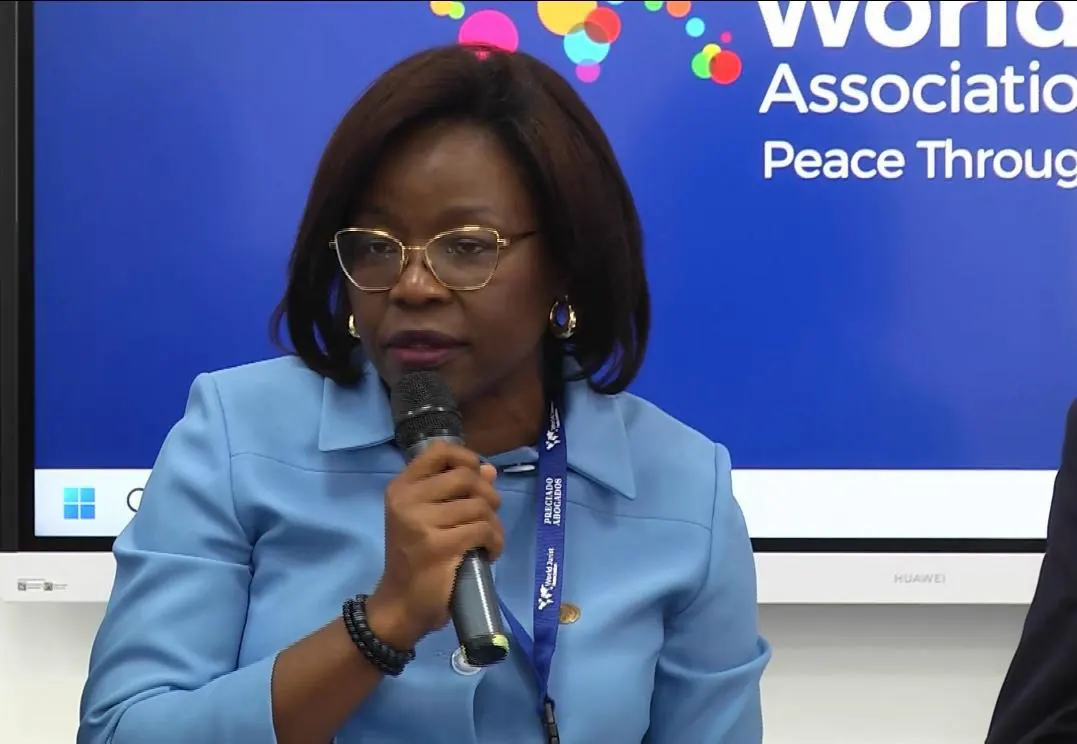
Santo Domingo, the capital of the Dominican Republic, has been hosting since 4 May the World Law Congress, an event that brings together more than 5,000 participants from 84 countries.
Speaking at the event, the President of the Constitutional Court, Justice Laurinda Monteiro Cardoso, gave an extensive address on the role that Constitutional Courts play, in times of danger to democracy, in defending the dignity of the human person.
Read in full the address by the President of the Constitutional Court of the Republic of Angola, Justice Laurinda Prazeres Monteiro Cardoso, delivered this Monday:
HER EXCELLENCY THE PRESIDENT OF THE SUPREME COURT OF THE SLOVAK REPUBLIC, DR JÁN SIKUTA,
DISTINGUISHED CONGRESS PARTICIPANTS,
LADIES AND GENTLEMEN,
It is with great enthusiasm that I take part in this 29th World Law Congress, on the theme “A world governed by law, not by force”, on which we are all invited to reflect, particularly in view of the alarming situations of war, increasingly widespread in various latitudes of the globe, and the systematic violations of fundamental rights, overt or veiled, to which many peoples are subjected today.
With regard to the theme, and with reference to the reality of constitutional jurisdiction in Angola, Article 1 of the Constitution of the Republic provides that “Angola is a sovereign and independent Republic, founded on the DIGNITY OF THE HUMAN PERSON (...). (...). This means that the principle of dignity is the beginning and the end upon which the Constitution of the Republic of Angola rests.
On a first reading, it is possible to see how the Constitution of the Republic of Angola affirms the primacy of the person in relation to the State and the centrality of human rights, rejecting the extreme positivism of the 19th century and thus adopting the model of the “inverted pyramid”, which starts, first and foremost, from fundamental rights and only then extends to the State.
Categorically, the principle of human dignity signals the primacy of the rights of the person in relation to the State, representing the fundamental basis of contemporary constitutionalism, whose main objectives are the enhancement and development of the person, combined with the limitation of the powers of the State.
The principle of the dignity of the human person plays a fundamental role in the interpretation and integration of the other fundamental rights. Fundamental rights and human rights are intrinsically related, which is why the Constitution, in Article 26(2), provides that constitutional and legal provisions relating to fundamental rights must be interpreted and integrated in accordance with the UDHR (Universal Declaration of Human Rights), the ACHPR (African Charter on Human and Peoples' Rights) and the international treaties on the matter ratified by Angola.
This principle also guides judicial decisions and reflects the commitment to justice, equality and respect for humanity. As Professor Wolfram Hofling, of the University of Cologne in Germany, argues, the Constitutional Court, as the supreme interpreter of the Constitution, must resist the temptation to distort the concept of human dignity as a basis for building a better world, even if this may jeopardise the effective application of the Constitution.
In stating its inviolability, Article 1 of the Constitution of the Republic of Angola enshrines a fundamental right, which is described as a constitutional principle, a norm of State legitimacy, the Archimedean point of the Constitutional State or as the highest legal value of the Constitution.
These conceptual variations merely underline the exceptional importance of the principle of human dignity, which is expressed legally in its immutability, established in subparagraph (a) of Article 236 of the Constitution of the Republic of Angola.
In contrast with the doubts still expressed by part of legal scholarship, it should be stressed that, in the Angolan context, the principle of the dignity of the human person does not merely represent an objective right, but also takes on the nature of a subjective public right, like the other fundamental rights. This quality derives unequivocally from Articles 1, 2, 28 and 56, all of the CRA, which enshrine the obligation of all State authorities to respect and protect human dignity.
All State authorities therefore have the obligation to respect human dignity. This obligation expresses one of the dimensions of the protection conferred by a fundamental right, namely that of ensuring protection against violations of human dignity perpetrated by the State itself. This requirement of respect materialises, above all, at the moments when the individual is directly confronted with public authorities or is in the custody of the State. State power must serve public purposes and never be an instrument for the humiliation or dehumanisation of citizens.
In a Constitutional State such as ours, it is precisely everyday cases that demand the greatest attention: the mother who sees her child die for lack of medical and pharmaceutical care; the citizen wronged by the power of the State in claiming his or her property through expropriation or appropriation; the suspect tortured by the police before any judicial decision; the inaction of State bodies in the face of the hunger and thirst of war refugees; taking justice into one's own hands through torture, corporal punishment and other archaic punishments, situations which, unfortunately, are often excluded from constitutional review by the constitutional jurisdictions of States. Indeed, as Martin Luther King said, “injustice anywhere is a threat to justice everywhere”.
The expression human dignity, present at the very beginning of the constitutional text, represents at the same time a retrospective and a guideline for the future: it refers to the horrors experienced during more than 30 years of civil war and, at the same time, contains the promise that the State will neither cause nor permit new violations of the dignity of the human person. It is from this perspective that the extensive case law of the Constitutional Court of Angola has been consolidated, as expressed in its judgments:
Judgment No. 122/2010
Available at https://www.tribunalconstitucional.ao/media/lljjlswo/122.pdf
In a criminal case that attracted wide media attention in the country at the time, the defendants were forced to wear prison service clothing and images of the accused were captured during the trial hearing, with live broadcast on national television. On appeal, the Constitutional Court upheld the Appellants' request and held that the imposition of the clothing and the manner in which the defendants were treated amounted to a manifest and reprehensible offence against their dignity and personal integrity.
Judgment No. 379/2015
Available at https://www.tribunalconstitucional.ao/media/ulpnrqyw/379.pdf
In this Judgment, the Constitutional Court reviewed, on appeal, a decision of the Supreme Court that had refused an application for habeas corpus and, although it dismissed the appeal, considering that the decision under appeal did not violate the appellants' fundamental rights, it nevertheless ruled that the Appellants' detention should cease as soon as the Law on Precautionary Measures in Criminal Proceedings (which was then in vacatio legis) entered into force, also by virtue of the principle of retroactive application of the more favourable law.
Judgment No. 887/2024
Available at https://www.tribunalconstitucional.ao/media/4vwhixix/ac%C3%B3rd%C3%A3o-887.pdf
With the right to individual liberty at stake, understood as a corollary of the principle of the dignity of the human person, the Constitutional Court ruled in favour of restoring the Appellant to liberty, considering that there had been a violation of the principles of criminal legality, subsidiarity and liberty when the precautionary measure of pre-trial detention was applied to the defendant without the requirements of adequacy, necessity and proportionality of the measure in relation to the offence in question having been met in that case.
Judgment No. 884/2023
Available at https://www.tribunalconstitucional.ao/media/oiko1dgg/ac%C3%B3rd%C3%A3o-884.pdf
In the judgment in question, the Constitutional Court held that “the prohibition of multiple penalties under Article 65 is linked to the dignity of the human person and to the principle of the rule of law. Within its scope of application, the protection of the dignity of the human person is specified mainly in Articles 67, 72 and 174, all of the CRA”.
In view of the record of case law in applying the principle of the dignity of the human person, we feel comfortable in stating that the Constitutional Court of Angola (TCA) plays a crucial role in giving meaning and importance to the recognition of human dignity as a fundamental human right.
Starting from the acceptance of the truth enshrined by NELSON MANDELA that “Education is the most powerful weapon which you can use to change the world”, it has not been only at the adjudicative level that the Constitutional Court has played a central role in defining, protecting and promoting human dignity as a fundamental right, ensuring that this principle is given effect in legal and social practice.
In this regard, the Constitutional Court of Angola has made concerted efforts to promote the constitutional literacy of citizens, promoting the translation of the constitutional text into the national languages, creating content for children and holding meetings with communities (Ondjango), thereby recognising that the first step towards respect for the dignity of the person is knowledge of one's rights and duties.
Dear Colleagues,
Ladies and Gentlemen,
Each case or right has its own specificity. Respect for the dignity of the human person is a fundamental guiding line for determining the scope of constitutional rights. It therefore serves as a starting point and a hermeneutic limit for securing the other rights, since human dignity gives concrete form to the value of the human person as the ultimate end to be protected by Law.
It is noteworthy that, in the Angolan legal landscape, the different perspectives on human dignity mentioned above do not diverge significantly. This is explained, as already mentioned, by the structuring role that this principle plays as the basis and foundation of the State. The State cannot, therefore, fail to protect the human being, preserving his or her identity, integrity and dignity. The dignity of the human person is inviolable and constitutes the foundation of the Constitution of the Republic of Angola.
Criticism should therefore be directed at those States whose Constitutions proclaim the principle of human dignity as the highest value but which, in practice, coexist with the impoverishment of their populations and high rates of infant mortality, and with the inability to guarantee, through their bodies, the right to a decent standard of living, namely: access to the benefits of social welfare, medical care and the material conditions indispensable to physical existence and to a minimum level of participation in the social, cultural and political life of the State.
Human dignity precedes the State. It cannot be conceived as a mere consequence of the State's self-limitation. The human person should not and cannot be a servant of the State. On the contrary, it is the State that must be at the service of the person.
I conclude, inspired by the thinker IMMANUEL KANT, when he said that “everything has its price, but the human being has dignity”. Well, I would say that the human being is in itself the very value, that which matters most! Hence, to speak of the human being and of dignity ought to mean the same thing.
Thank you very much for your most worthy audience, attention and patience