
Translated from Portuguese. The Portuguese version prevails. Ler em português
“Justice in Building the Rule of Law in the 21st Century” is the central theme of the 11th Congresso Internacional de Direito na Lusofonia (International Congress on Law in the Lusophone World), which Luanda is hosting from today, Tuesday the 13th, until next Friday, 16 May 2025, an event held jointly by the Constitutional Court, the Attorney General's Office (PGR), the Faculties of Law of Agostinho Neto University and of the Catholic University, and the Lusophone Law Research Network (REDIL).
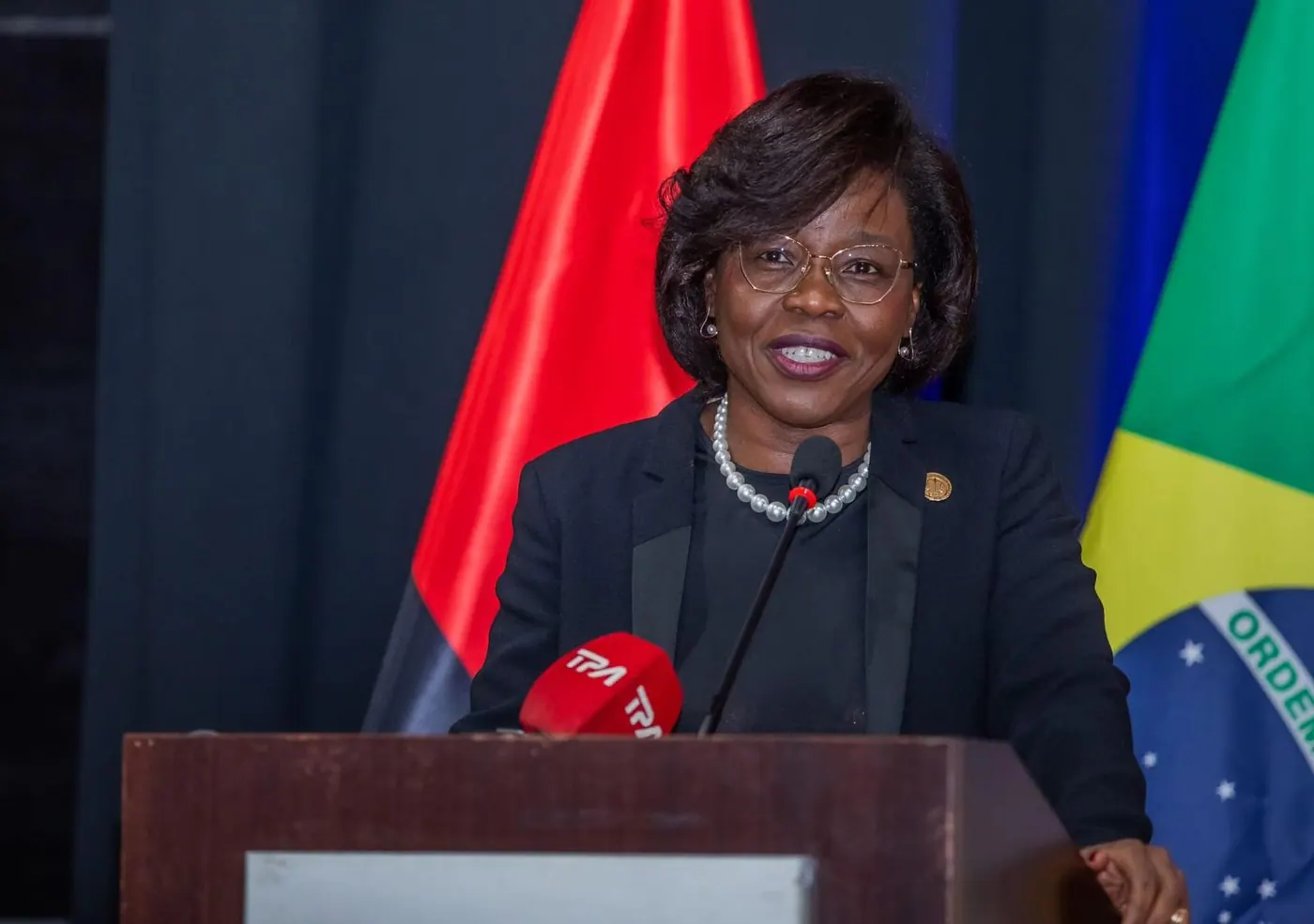
The opening address delivered by the President of the Constitutional Court, Justice Laurinda Monteiro Cardoso, in full.
It is with great honour, pleasure and a sense of responsibility that, on behalf of the Bench and the staff of the Constitutional Court, we welcome everyone present at this Opening Ceremony of the XI Congresso Internacional de Direito na Lusofonia, under the theme "Justice in Building the Rule of Law in the 21st Century".
This Event follows on from the main conclusions of the X Congress, held in Braga, Portugal, in May 2024, and is of special significance to us for two fundamental reasons:
- The first is the depth and topicality of the chosen theme since, increasingly, we are witnessing episodes of axiological orphanhood of Law in various legal realities around the world! Law appears as a mere ordering of politically imperative canons, devoid of intrinsic value, without any tendency towards universalist altruism, becoming much more a normative set empty of human ideals, exclusively formal, circumstantial and sectarianly utilitarian;
- The second reason is that the event also takes place as part of the commemorations of the 50th Anniversary of the Independence of the Republic of Angola, which likewise marks the birth of Angolan constitutionalism, which, in turn, was in its time decisive for the genesis of the matrix of a true State based on the Rule of Law in Angola, with its inherent postulate of justice, which is still in continuous maturation today!
For this historical reason too, the present moment constitutes a unique opportunity for legal and constitutional reflection, at both institutional and jurisdictional level, as well as for reaffirmation and renewal for all of us, in view of our irreversible commitments to justice and democracy in our countries.
Dear Congress Participants,
In Angola, the Constitutional Court plays an extremely important role in the building and declaration of the democratic State based on the rule of law, in the defence of the Constitutional Law and in preserving the integrity of the legal order. This fundamental jurisdictional body cannot be indifferent to the need to consider the foundational "fundamentality" of justice as one of the main value-based cornerstones of Law, without which even Constitutional Law resulting from a regular constituent process is stripped of its consequent and natural legal grandeur within the framework of the system!
In this regard, the relationship that Hans Kelsen draws between justice and the legal order is pertinent, when he says that “Justice is essentially a quality attributed to a social order which regulates human behaviour by norms”.
And yet, despite all these axioms so often stated, reproduced and translated countless times, the difficulty of asserting not only Law, as an unavoidable perspective in the regulation of human life in society, but above all justice as an inherent part of it, is all too evident in reality.
A would-be Law constructed in this merely formal way does not meet the criteria for serving as a guarantee of fundamental rights, failing to ensure such elementary guaranteed postulates as the principles of equality, proportionality (equity) and freedom and, even more, of respect, first and foremost, for human dignity itself!
Excellencies, Ladies and Gentlemen,
From this perspective, the joint initiative with the Faculties of Law of Agostinho Neto University and the Catholic University of Angola, the Military Prosecutor's Office and the Lusophone Law Research Network (REDIL) to debate this topic represents much more than a strengthening of academic and institutional cooperation - of great importance for Portuguese-speaking countries and regions - it is a true safeguard of the dogmatic and scientific spirit that seeks to preserve the nature of Law and to ground its evolutionary paths, without Law losing its essence in terms of values.
Justice, as the foundation of the Rule of Law, is not exhausted by the technical application of the norm, not even of constitutional norms. In order to give substantive density to norms, it requires permanent dialogue with the social, political and cultural reality of our peoples; and, at the jurisdictional level, it further demands a dialogue with the practical adjudicative criteria of the specific case, with a view to the best realisation of Law.
For this reason, this Congress proposes a multidisciplinary, critical and scientific-academic approach, from which we anticipate the illumination of paths and a better understanding of the mechanisms for materialising justice within a holistic vision of "juridicity", as a necessary axiological element for the ever more necessary building and description of the Rule of Law.
Like law, justice is by nature conservative and often resists the processes of transformation that contemporary times demand, and its practical application must therefore be re-understood in the light of other levels of pre-existing values, or even of other values that the contemporary collective consciousness accepts.
In an increasingly divided world, beset by inequalities, conflicts, wars and crises of various kinds, discussion of topics relating to justice and Law appears indispensable and an important element in designing solutions to these problems that afflict us, both individually and collectively.
This is also the role of academia: to transform social problems into projects of scientific analysis, whose pursuit of results does not neglect the definition and adequacy of the instruções as a criterion intrinsic to the just and dignified existence of human beings and to the sustainability and progress of their societies.
We trust that this Congress, as a privileged space for sharing knowledge, for the exchange of ideas and for the joint construction of ideals that best serve the peoples of the Lusophone world, will be a truly fruitful laboratory of analysis, from which agents, reagents and solutions can be produced, in a blend of approaches to the elements that make up legal chemistry.
Excellencies, the challenges we face today in building the democratic State desativaram a renewed humanist perspective. At a time when technologies such as artificial intelligence promise to transform justice, we run the risk of losing what is essential: the human dimension of adjudication. Efficiency cannot override the capacity to take into account, in each case, human stories with all their complexities and vulnerabilities.
The Lusophone space, spread across four continents, represents an extraordinary laboratory of legal and constitutional experiences. From Angola, which is celebrating half a century of independence, to the centuries-old Portuguese tradition, and through the experiences of many countries, we have built a common heritage that allows us to assert, in a polarised world, the value of intercultural dialogue as a tool for fairer societies.
I conclude by recalling the Aristotelian maxim " Justice belongs specifically to the State. And it is the order of the State that ensures justice ". This still vital maxim reminds us that the pursuit of justice is not merely a technical task, but the moral foundation that legitimises the State. May this Congress strengthen that human sensitivity without which Law becomes a dead letter, and justice an unfulfilled promise.
I wish you all a prolific, inspiring and enriching Congress.
Thank you very much for your attention
Laurinda Prazeres