
Translated from Portuguese. The Portuguese version prevails. Ler em português
INAUGURAL LECTURE
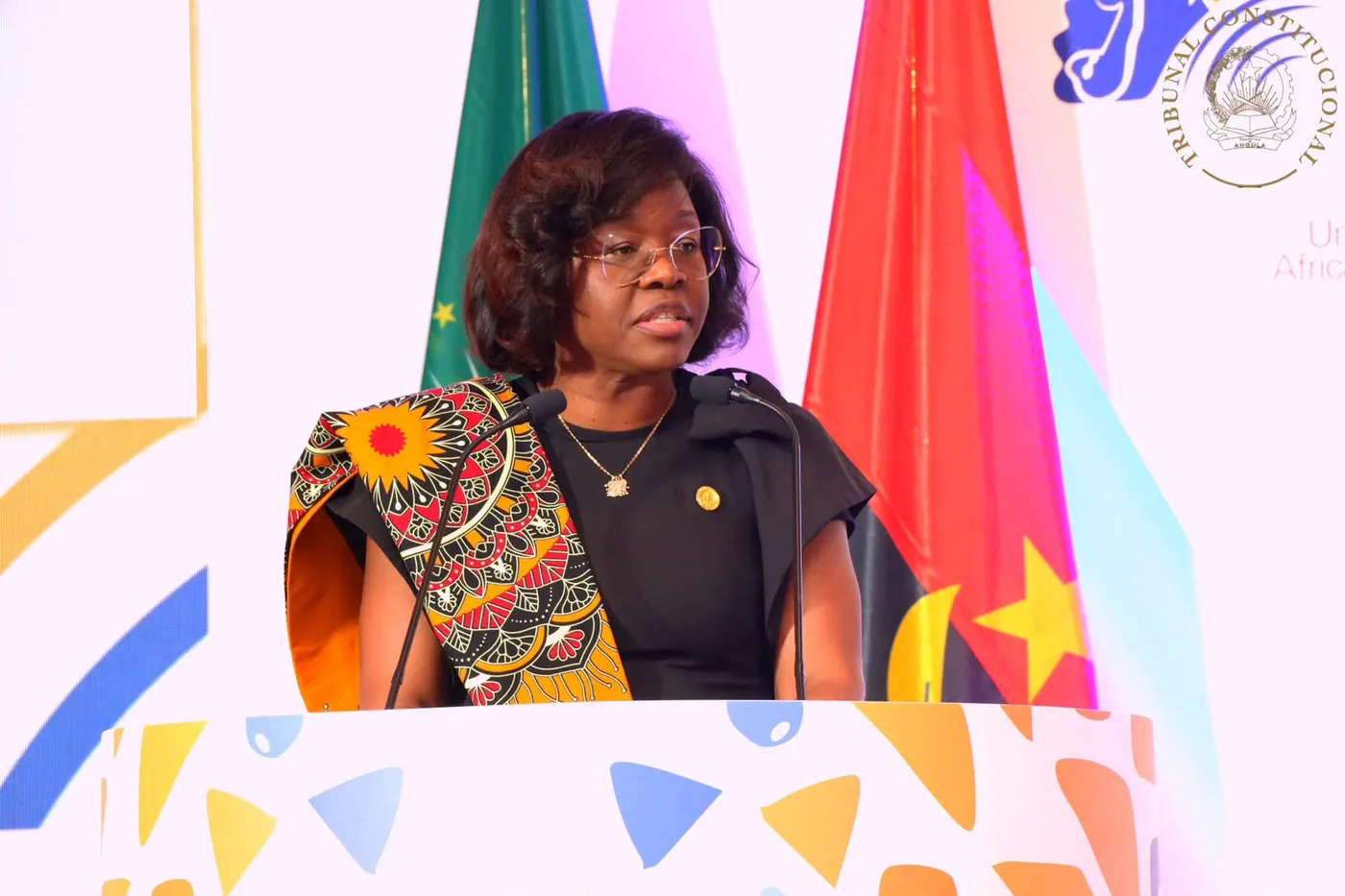
The President of the Constitutional Court, Justice Laurinda Prazeres, delivered the inaugural lecture of the 2nd International Women's Forum for Peace and Democracy on the morning of Thursday, 9 July 2026, in Luanda. The event is hosted by Angola and jointly organised by the Government of the Republic of Angola and the African Union.
In her address, the President of the Court covered central themes relating to the role of women in promoting peace, democracy, good governance and the rule of law, highlighting the importance of strengthening women's participation in decision-making processes and in the consolidation of democratic institutions.
Read in full the address delivered by the President of the Court, Justice Laurinda Prazeres.
* Her Excellency Dr Maria do Rosário Bragança, Minister of State for the Social Sector;
* Her Excellency Ambassador Liberata Mulamula, Special Envoy of the Chairperson of the African Union Commission on Women, Peace and Security;
* Her Excellency the Vice-President of the National Assembly, Dr Arlete Chimbinda;
* The Honourable Vice-President of the Supreme Court, Dr Efigénia Clemente;
* Your Excellencies the Ministers of State;
* Her Excellency Dr Doris Mpoumou, Special Representative of UN Women to the African Union Commission and the United Nations Economic Commission for Africa;
* Her Excellency Dr Lídia Arthur Brito, Assistant Director-General of UNESCO for Priority Africa and External Relations;
* Your Excellencies, Aides to the Holder of Executive Power;
* Ambassadors, Distinguished Diplomatic Corps;
* Distinguished Speakers and Guests.
My warmest greetings.
Allow me to start from a distinction that is simple, yet decides everything. There are, in the world, two kinds of force. There is the force that destroys and the force that endures. Throughout almost the whole of human history we glimpse the struggle between these two forces, and all the wisdom of a people lies in knowing, in time, which of them deserves its trust.
There is a force that imposes itself through threat: it is the force of arms. It resolves things quickly and appears strong, but it has a secret: it lasts only as long as fear lasts. On the day the threat returns, the peace it imposed falls apart. Africa knows this force well and knows its price.
There is another force that does not shout: it is the force of the norm, of the law, of the Constitution. It seems slow, it seems fragile, but it has the opposite secret: the more we respect it, the stronger it becomes. The peace it builds does not depend on fear; it depends on agreement, and that is why it holds. Transforming Africa, Excellencies, means trusting, once and for all, in the second force.
I therefore welcome with deep admiration the holding of this 2nd International Women's Forum for Peace and Democracy, which Angola has the honour of hosting within the framework of the Luanda Biennale 2026. Initiatives such as this are not just one protocol occasion among so many others: they are an act of collective courage, because they place women at the centre of the conversation about the destiny of the Continent. And we could not have chosen a more fitting banner for these times than the one that brings us together: “Transforming Africa: Empowering Women in Leadership for Peace and the Inclusive Growth of the Continent”.
I speak to you today not only on behalf of the institution I represent, but as a woman addressing women. And I speak with a conviction I have long carried with me: woman, as the one who gives life, must also be at the centre of every decision about the life we want to build together — life in peace, life in freedom, life in dignity. She who sustains life at its most fragile beginning knows, like no one else, the price of protecting it to the very end.
The African experience demonstrates this clearly. In many of our communities, it was women who preserved family cohesion during periods of conflict, who kept their children's education alive, who rebuilt communities and held on to hope when all seemed lost. It is no accident that they are so often the architects of peace and the last to give up on it.
Every lasting construction requires a structural design; in the edifice of peace, that design is called the Constitution. The Fundamental Law is the architecture of peace, because it is what defines the paths along which power runs, how force is limited and which rights no majority can demolish. Where the Constitution is respected, conflict does not disappear, but it ceases to be resolved through violence and comes to be resolved through the norm. This is the great discovery of constitutionalism: the most solid peace is not born of the silence of arms; it is born of the word of the law.
Excellencies;
The 2010 Constitution of the Republic of Angola enshrines the principles of equality, human dignity, physical and moral integrity and the special protection of women and children, and the open clause of its Article 26 brings into play the major instruments that the international community has built up for this cause: the 1979 Convention on the Elimination of All Forms of Discrimination against Women, the principal international treaty on women's rights; the 1993 United Nations Declaration on the Elimination of Violence against Women, the first instrument to define in plain terms physical, sexual and psychological violence, whether committed within the family, in the community, or through the action or omission of the State itself; and the 2003 Maputo Protocol, the most comprehensive African instrument for the protection of women's rights, which obliges States to eliminate all forms of violence against women, to protect girls from abuse, to punish those responsible and to guarantee assistance to victims.
And this second force also has case law to confirm it. In 2018, the African Court on Human and Peoples' Rights, in the case of APDF and IHRDA v Republic of Mali, applied the Maputo Protocol for the first time and declared that the marriage law in that country simultaneously violated the Convention on the Elimination of All Forms of Discrimination against Women (CEDAW), the African Charter on the Rights and Welfare of the Child and the Protocol itself, directing the State to revise its legislation. In 2017, the ECOWAS Court of Justice, in the case of Dorothy Njemanze and Others v Federal Republic of Nigeria, also applied the Maputo Protocol for the first time in its history, and found against Nigeria for the arbitrary detention of, and sexual violence inflicted on, women presumed guilty merely for being out in the street at night, recognising the violation of their dignity. And as early as 2011, the African Commission on Human and Peoples' Rights, in the case of the Egyptian Initiative for Personal Rights and INTERIGHTS v Egypt, held the State responsible for failing to protect women journalists and protesters from sexual assault during a peaceful demonstration, affirming that violence directed at women because they are women is, in itself, discrimination. Three African courts, three countries, one single conclusion: the African norm already knows how to protect women; all we lack is the collective will to see it through to the end.
But today I want to bring you something more than the norm: I want to bring you memory. Because the second force, the force that endures, has always been, in Africa, the force of women. Not the force that raises armies, but the one that sustains communities. Not the one that conquers territory, but the one that safeguards the bond.
Let us remember Liberia, between 1989 and 2003, when the war seemed endless: it was Christian and Muslim women who, side by side, without distinction of faith, dressed in white and occupied the markets of Monrovia, week after week, with a single message: we want peace now. It was that same determination of women, under the leadership of Leymah Gbowee, that prevented the negotiators from leaving the meeting room in Accra until they had signed the peace agreement. Years later, those same women carried Ellen Johnson Sirleaf to the presidency, the first woman democratically elected head of State in Africa. The 2011 Nobel Peace Prize did not reward an episode: it rewarded a method.
Let us also remember Kenya, where Wangari Maathai understood, before many others, that the scarcity of water and firewood generated conflict between communities, and that planting trees, with networks of rural women, was also planting dialogue between rival ethnic groups. She taught us that peace is not only the silence of arms: it is economic security, it is law, it is everyday democracy.
An ancient African proverb teaches that "when the roots stand firm, the tree withstands the storms". Women have been, throughout our history, those discreet roots that sustain families, preserve collective memory and keep hope alive. Caring for women is, therefore, strengthening the very roots of peace in Africa.
These examples confirm what the United Nations recognises today, and what this Forum so aptly chose for its first panel, on the occasion of the twenty-fifth anniversary of Resolution 1325: peace agreements negotiated with the full participation of women are more likely to last. Including women at the peace table is not generosity. It is strategy. It is collective intelligence.
And allow me here a word about Angola. This country, which today welcomes you with open arms, does not make this Biennale an isolated gesture. Having had the honour of presiding over the Conference of Constitutional Jurisdictions of Africa, and having undertaken within it a commitment to permanent cooperation between our jurisdictions, Angola took a further concrete step at the beginning of this year, 2026: it institutionalised, at African Union level, the Constitutional Forum on the Rights and Guarantees of Young African Women and Children. We did so because we are convinced that placing women and young women at the centre of the conversation is not a one-day purpose; it is a State project, it is a commitment of the Continent.
Angola knows the price of peace because it knows the price of war. Our collective journey has taught us that reconciliation is not decreed; it is built daily, through institutions, respect for the democratic State based on the rule of law, inclusion and trust between citizens. It is this experience that we wish to share with Africa: the conviction that sustainable peace is born of justice, of the Constitution and of the participation of all, especially women. For too long, when speaking of women, we have spoken only of the first force: we have said how they are wounded, how they are silenced. It needed to be said, because violence against women and girls is a scourge that this Forum has the courage to seek to eradicate. But if we stop there, we commit an injustice: we look at women in terms of the force that wounds them, and not of the force that they represent.
I therefore propose to you, Excellencies, distinguished participants, a decisive shift: from victim to guardian. To recognise women not for the violence they suffer, but for the norm they uphold. Not as the object of the first force, but as the constitutional subject of the second. This second force can only prevail if we choose it together. Therefore, of the Member States of the African Union, I ask for the full ratification of the instruments that protect women and girls. Of governments, I ask for real leadership positions for women, not symbolic ones. Of civil society, I ask for the vigilance that keeps the agreed norm alive. Of international partners, I ask for support that respects the African authorship of our solutions. And to the young women here, I leave you with one certainty: you are not the future, you are the present. Your voice counts today.
Excellencies
I end where I began. There is the force that destroys and the force that endures. The first builds walls, the second builds bridges. The first feeds fear, the second inspires trust. The first belongs to the past we wish to overcome, the second belongs to the future we have a duty to build. May Africa choose, once and for all, the force of the Constitution, of justice, of peace and of human dignity. And may it continue to entrust to its women the place that has always been theirs: not only that of guardians of life, but also that of architects of peace, of democracy and of the future of our Continent.
Thank you very much.