
Translated from Portuguese. The Portuguese version prevails. Ler em português
The Ibero-American Conference of Constitutional Justice opened this Tuesday, 12 May 2026, in Brazil.
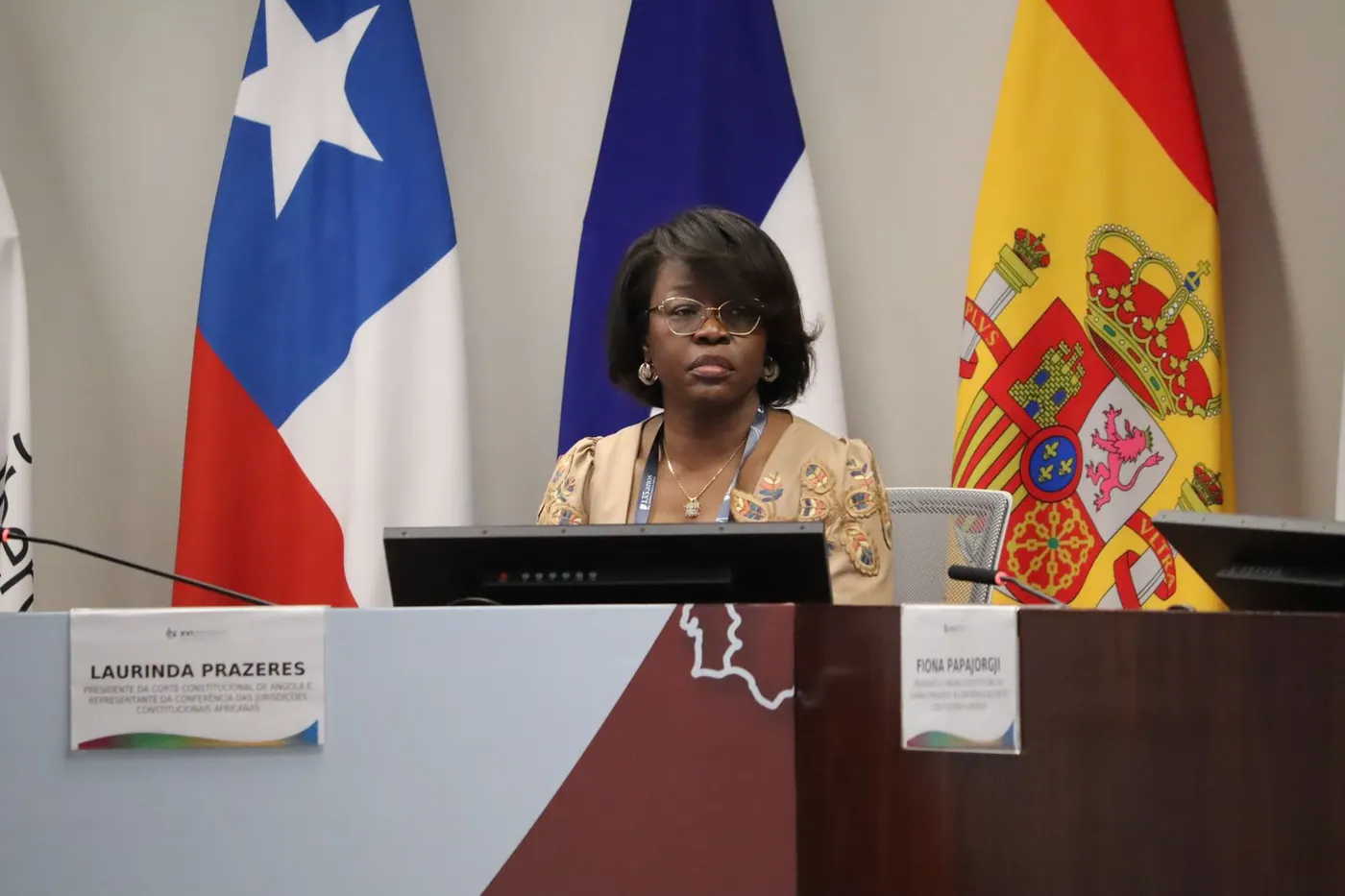
Read in full the address delivered by the President of the Constitutional Court of Angola, Justice Laurinda Prazeres, who spoke on behalf of the 50 members of the Conference of Constitutional Jurisdictions of Africa, CJCA.
Your Excellency, President of the Federal Supreme Court of Brazil, Justice Luiz Edson Fachin;
Your Excellency, President of the Ibero-American Conference of Constitutional Justice, Mr Enrique Arnaldo Alcubila;
Your Excellencies, Presidents, Vice-Presidents and Judges of the Constitutional and Supreme Jurisdictions of the Ibero-American Conference;
Representatives of Regional and International Institutions;
Dear Colleagues;
Ladies and Gentlemen.
It is with great honour and genuine joy that I take the floor before this distinguished Assembly, on behalf of the 50 Members of the Conference of Constitutional Jurisdictions of Africa – CJCA, and, in particular, of its President, the Chief Justice of the Supreme Court of Zimbabwe, Luke Malaba, to salute this sixteenth edition of a forum which, over the years, has proved to be much more than a meeting of Jurists, and rather a privileged space for the sharing of experience, for collective construction and for the renewal of our commitment to the values that unite us, rooted in the protection of the principled and teleological frameworks of our Constitutions.
On arriving in Brazil — a land of greatness, of diversity and of a Constitution that is, in itself, a declaration of hope —, we feel at home. We have come as brothers, as partners in a common cause: that of ensuring that constitutional justice is, in each of our countries, the shield of the most vulnerable and the anchor of democracy.
Africa, Portugal, Spain and Latin America share not only the memory of struggles that cost their peoples blood and dignity, but also the unwavering determination to build legal orders that place the human being at the centre of all attention and concern. We share the challenge of constitutionalising hopes in a time of uncertainty. With some, we also share the language — that extraordinary bridge that is Portuguese, capable of carrying, from Luanda to Brasília, from Lisbon to Cabo Verde, from Maputo to São Tomé or to Bissau, not necessarily the entirety of the same values or socio-cultural realities, but, above all, the essence of common legal references and conceptions, as well as a shared vision of the dignity of the human person, of freedom and of the Rule of Law.
But our ties run deeper still: the historical, linguistic and cultural bonds that unite Africa and the Ibero-American States find concrete expression today in the field of justice and Law, without prejudice to the autonomy of our paths as sovereign and independent States.
The sharing of experience in matters of constitutional jurisdiction, judicial independence, the modernisation of technological systems and processes, and the promotion of fundamental rights has contributed decisively to the strengthening of the Rule of Law in our States.
Therefore, within this Ibero-American Conference, Africa is not a distant guest: it is an active voice, a committed presence, an interlocutor that brings the richness of its own experiences and constitutional practices — of the peace processes that culminated in Fundamental Charters, of the attempts to root constitutionalism in still fragile soils, of the case law that seeks to balance tradition, usage and custom, modernity, identity and universality - I am speaking to you, therefore, of the ceaseless search for a fair balance.
In this sense, the dialogue between our jurisdictions is neither an academic luxury nor even an institutional diversion. It is a strategic necessity.
When an African constitutional court faces questions of fundamental rights in contexts of scarce resources, Ibero-American case law can light the way. When the courts of Latin America debate the relationship between sovereignty and international law, the African experience offers reflections that cannot be ignored. We learn from one another. And it is this mutual learning that makes us stronger, wiser and more capable of serving our jurisdictions with integrity and with excellence.
In this year in which the Federal Supreme Court of Brazil celebrates one hundred and thirty-five years, we pay tribute to an institution that has shown, over generations, that constitutional justice is not limited to declaring the law: it interprets the present in the light of the founding values and opens the way to the future. That is our collective role — that of guardians not only of the written constitutions, but of the spirit that inspired them (guarantor of compliance with the Constitution, guardian of the fundamental rights of citizens and review of the constitutionality of the actions of all public authorities).
The programme that awaits us over these two days — from human rights to judicial independence, from new technologies to climate justice — reflects the problems that beset our societies, and therefore brings timely, necessary and pertinent arguments with a view to the search for solutions drawing on individual, national and regional experiences.
May this 16th Conference therefore be more than a moment of debate: a moment of reaffirmation — of our solidarity, of our common determination and of our unshakeable faith that, when constitutional judges from different continents sit at the same table, their aim is, at the very least, for the world to become a fairer place.
On behalf of the Conference of Constitutional Jurisdictions of Africa, I thank you for the invitation and for your attention.
A heartfelt thank you to all those who made this meeting possible.