
Translated from Portuguese. The Portuguese version prevails. Ler em português
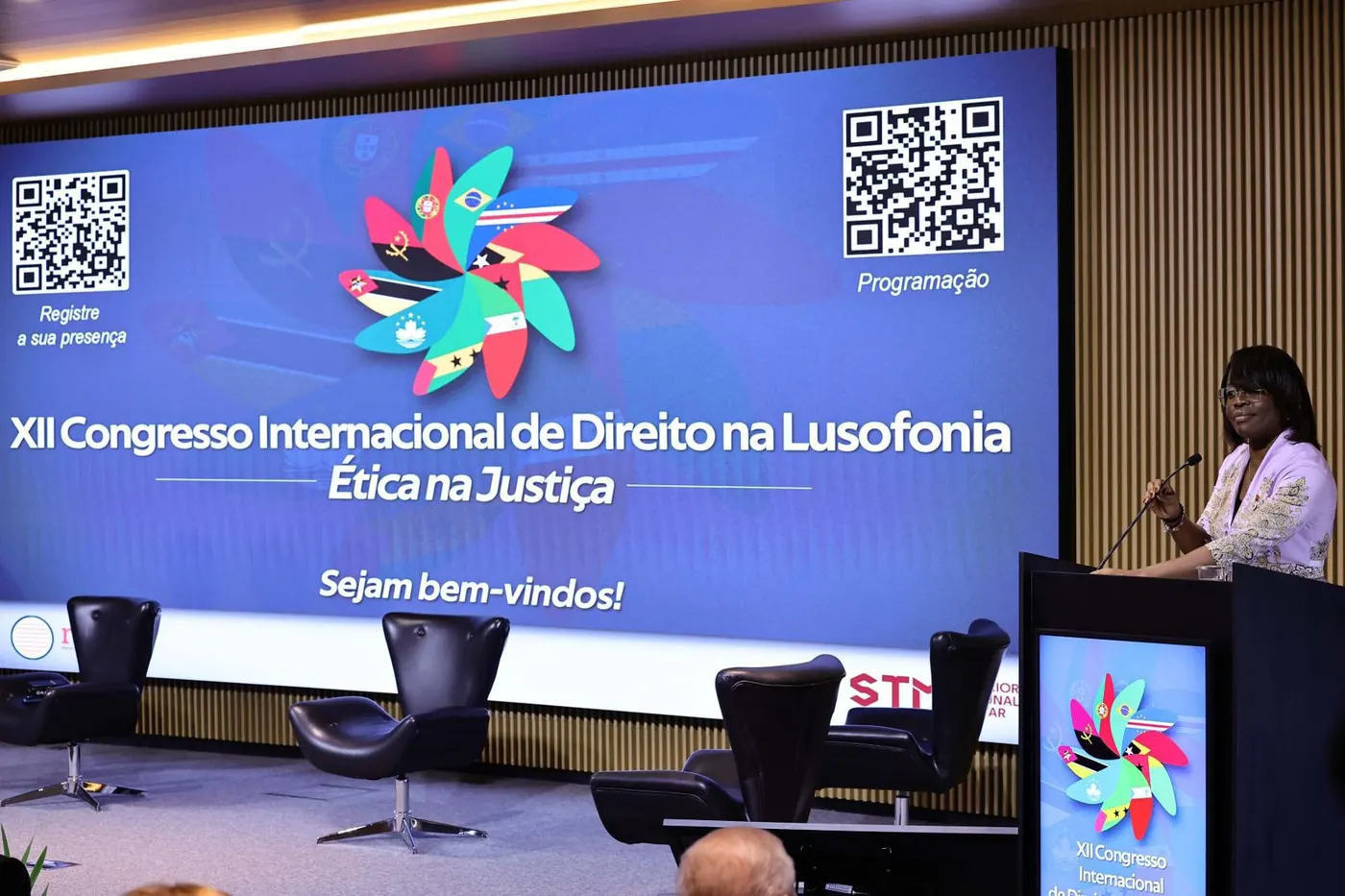
A delegation from the Constitutional Court is in the city of Brasília, Federative Republic of Brazil, where, since 27 April, it has been taking part in the XII Congresso Internacional de Direito na Lusofonia (12th International Congress on Law in the Lusophone World).
The event, organised by the Research Network on Law in the Lusophone World (Rede de Investigação em Direito na Lusofonia, REDIL), brings together members of the legal and academic community of Angola, Brazil, Cabo Verde, Guinea-Bissau, Mozambique, Portugal, São Tomé and Príncipe, Timor-Leste and Macau.
The opening session of the event was attended by the President of the Superior Military Court, Justice Maria Elizabeth Rocha, as well as by the heads of REDIL, Professors Mário Monte, from Portugal, and Osvaldo Serra Van-Dúnem, from Angola.
Also at the opening session, the President of the Constitutional Court of Angola, Justice Laurinda Prazeres, delivered the event’s inaugural lecture, speaking on Ethics and Constitutional Justice in the Lusophone Area.
Read in full the address by the President of the Constitutional Court of Angola.
——//——//——//——//——//——-//
ETHICS AND CONSTITUTIONAL JUSTICE IN THE LUSOPHONE AREA
Your Excellencies, Dear Colleagues, Distinguished Professors, Distinguished Congress Participants, Ladies and Gentlemen
A special greeting to Justice Elizabeth Rocha and, on behalf of the Angolan delegation, our thanks for the invitation and for the excellent welcome.
To REDIL we reiterate our availability, commending its achievements and its consistency in maintaining the Agenda of this Congress.
It is with deep honour, and with an awareness of the responsibility that this moment calls for, that I take the floor at this inaugural session.
This gathering stands as a moment of particular relevance for all those who devote themselves to the study, understanding and practice of Law, at a time when the demand for ethics is becoming ever more present and inescapable in contemporary societies.
More than an academic meeting, this is a space for building thought, for comparing experience and for affirming paths that favour a justice that is more conscious, more humane and more faithful to the values of the common good.
At present, there has been a growing call for ethics in the most diverse areas of social life, both nationally and internationally. Thinkers, professionals and institutions feel keenly the need to legitimise their actions in the light of sound principles.
This movement covers areas as diverse as Law, Economics, Politics, Medicine, the Legal Profession, the Judiciary, Academia and the business sector, among many others. In all these fields, there is a growing awareness that the exercise of any function with a significant social impact cannot be limited to the formal observance of rules, but must instead be guided by values, deontological principles and criteria of responsibility.
By choosing the motto “Ethics in Justice”, this Congress sets out to lay the foundations for a critical and structuring debate around certain fundamental questions, for example that of understanding how the pursuit of justice guided by ethics is articulated and legitimised in a context governed by formalised positive law? What is the scope of an ethical response in the absence of a legislative framework? What relevance does such a response assume in the face of legal norms considered insufficient or inadequate? And what should be the role of ethics in the exercise of the functions of legal practitioners?
Consequently, bearing in mind the different topics on the programme of this Congress, the aim is also to highlight the importance of ethics in the conduct of the various actors in the legal universe - judges and prosecutors, lawyers, court officers, academics and other professionals, on the premise that legal practice can and must be harmonised with sound ethical principles. From this perspective, individual and professional responsibility converge towards the realisation of a collective good that is fairer, more balanced and more conscious.
Accordingly, taking as a reference the function I currently perform in my country, I have taken the liberty, by way of introductory notes, of focusing my address on «Ethics and justice in the exercise of the judicial function in the Lusophone area»
I therefore propose to revisit some concepts and structuring elements of ethics in the performance of the judicial function, as well as their implications for the functioning of the constitutional State.
The well-known definition of justice attributed to Ulpian – the constant and perpetual will to give each person what is due to them – expresses an ethical standard that goes beyond the mere mechanical application of norms. When we affirm that Law is the means of achieving justice, we recognise that laws do not exist merely to regulate behaviour, but also to give concrete form to values such as equity, dignity and the common good.
At the theoretical level, the relationship between ethics and justice has been widely discussed, revealing the difficulty of establishing a univocal concept of ethics within the human sciences. Even so, it is generally accepted that ethical conduct is defined by the system of values that guides life in society.
Indeed, as a rule, constitutional texts inspire the exercise of the judicial function and the private life of the Judge, but they also provide the fundamental and essential indications regarding the judge’s professional ethics. So much so that disciplinary codes of ethics may be regarded as concrete expressions of the translation of constitutional principles into rules of conduct, some socially enforceable, others backed by disciplinary sanctions.
Thus, the principle of equality and the rule of the equal dignity of persons represent fundamental canons in the exercise of the judicial function, to be observed in relations with all those who appear in the procedural setting.
It is to this extent that it can be said that the constitutional and general dimension of ethics, as extensively developed by Habermas, Dworkin and others, and here among us by Pontes de Miranda, constitutes an immanent source of inspiration for positive Law. Although they start from different premises, they all consistently highlight the need for an articulation between ethics and law, especially in the field of the interpretation, argumentation and legitimation of legal decisions.
Reflection on the relationship between ethics and justice allows us to conclude that the demand for justice which society addresses to ethics finds its justification and legitimation in two sets of factors. On the one hand, in the functional and inevitable incompleteness of the legal order, in its multiple aspects; on the other, in the consequent need to fill those gaps and shortcomings in the light of ethical principles, which make it possible to adapt the Law to the concrete demands of social life. This allows us to say, with Pontes de Miranda, that Law is a social phenomenon that seeks peace and ethics, the latter being consistent with legal certainty and the realisation of justice.
The specific nature of the exercise of the judicial function is, in itself, its most solid form of legitimation. For this reason, the safeguarding of values such as diligence, loyalty, probity, correctness, discretion and the spirit of service inherent in the function is essential to its credibility.
In short, it is a matter of combining the ethics of conviction and the ethics of responsibility, according to Max Weber’s well-known formula. By virtue of not only being, but also appearing, impartial and independent. Each judge must become the guardian of his or her own image, both in professional life and in social life.
In general terms, it can be said that ethics and justice are two inseparable axes of the exercise of the judicial function, from the judge’s entry into the profession, throughout the exercise of judicial office and until retirement.
Dear Congress Participants, Esteemed Colleagues, Ladies and Gentlemen,
The motto of this Congress and the representativeness of this linguistic group call on us to make brief reference to our constitutional landscape.
It is, indeed, well known that the Constitution is simultaneously a supreme legal norm, and therefore the Lex Mater, a political and social pact and, thirdly, a moral commitment. For the Constitution is more than a norm and more than a pact: it is a commitment that a community makes to itself that it will treat every person with dignity, that it will not tolerate arbitrariness, and that it will pursue justice even when justice is uncomfortable. It is, therefore, the ethical horizon towards which the community is moving.
At the level of the PALOP (Portuguese-speaking African countries), this threefold dimension takes on particular significance. Constitutional history records that the Constitutions of the Portuguese-speaking African countries were born in contexts of rupture — independence, war, political transition, whose origins coincide with the founding origin of the State — and therefore carry a particularly intense burden of promise. They are Constitutions that not only organise the State, but found it.
This subject calls for a reflection that I consider indispensable and timely and, for that reason, allow me these brief notes on the challenges that are specific to it and that cannot be ignored.
The first is the challenge of State-building. The institutions are young. The traditions of constitutional review are recent. The consolidation of a culture of constitutionality — that is, the social and political habit of respecting the Constitution as a limit and as a guide — is an ongoing process, not a finished reality.
The second is the colonial legacy. The legal systems of the PALOP were born on structures inherited from colonialism, with their continuities and their ruptures. The challenge is to build a constitutional law that is at once modern and rooted, that engages in dialogue with the European legal tradition without submitting to it, and that incorporates customary law without relinquishing fundamental rights.
The third is cultural pluralism. The Portuguese-speaking African countries are, by nature, plural: plural in languages, in ethnic groups and in traditions. The Constitution, in this context, cannot be the document of an urban, literate elite that is imposed on everyone else. It must be — or become — the document of all.
The fourth is institutional weaknesses. The independence of the judiciary, the administrative capacity of the State, effective access to justice — these are real, everyday problems that condition the effectiveness of the constitutional promise.
And the fifth, which encompasses all the others, is the need for rights to be effective. For a Constitution that is not complied with is a promise betrayed. And law that is not lived is a learned fiction. The gap between the written Constitution and the lived Constitution is perhaps the gravest ethical challenge of constitutionalism in the PALOP — and, to some extent, throughout the Lusophone area.
However, crossing different borders while still speaking the same language, we find, with the necessary adaptations, that these difficulties are not exclusive to the Lusophone area. All over the world, constitutionalism faces tensions that test its foundations.
Let us consider,
The tension between law and justice. When the law produces injustice, what prevails? Constitutionalism answers: the Constitution prevails, as the ethical measure of the law itself. But this answer requires institutional courage — the courage of constitutional jurisdictions to declare the invalidity of that which, while legal, is unjust.
The tension between the majority and fundamental rights, that is, balanced solutions in situations where the decisions of the majority meet an insurmountable limit in the rights of each person.
The tension between formalism and effectiveness. Law that is formal but not effective loses its legitimacy in the eyes of those it ought to serve. Constitutional ethics requires that law should not be content to exist in texts — that it should manifest itself in people’s lives.
The tension between political power and constitutional review. The independence of constitutional jurisdictions is the ultimate guarantee of the rule of law. When political power captures constitutional justice, the Constitution becomes an instrument of power instead of being its limit.
That is why it is said that constitutional ethics is the set of values that animate the legal order and guide its interpretation. It is what gives meaning to the norm beyond its letter. It is the reason why we interpret the Constitution in such a way as to protect the weakest, to limit the strongest and to ensure that no human being is reduced to an instrument of power.
Constitutional justice, in turn, is the system of judicial guarantee through which the supremacy of the Constitution is ensured and the conformity of laws and of acts of public authority with the Constitution is reviewed. It does so through procedural mechanisms such as: abstract prior and subsequent review proceedings, concrete review proceedings, amparo appeals, constitutional injunctions and Habeas Corpus, among others — which give effect to the constitutional promise.
It is, therefore, a promise that is renewed every time a court has the courage to say to the other powers: «this far and no further». It is a promise that is renewed every time a citizen finds, in the institutions, the protection that the Constitution guarantees them.
Your Excellencies, Dear Colleagues, Distinguished Congress Participants,
I conclude by stressing, once again, that the role of the judge in building a living, contextualised Law oriented towards the effective protection of fundamental rights entails an increased degree of responsibility, requiring continuous improvement and permanent fidelity to ethics, independence, impartiality and the values of the Rule of Law. Only in this way, therefore, will the judicial function be able to continue to assert itself as an expression of justice, a guarantee of freedom and a foundation of citizens’ trust in the institutions.
And I reiterate my appeal for the dialogue between Lusophone constitutional jurisdictions — already under way, but still incipient — to be one of the most promising paths towards democratic consolidation in our area, since constitutional case law does not travel only through academic citations; it also circulates through the force of example, the persuasiveness of argument and the demonstration that it is possible to do justice with rigour and independence.
Thank you very much for your kind attention.