
Translated from Portuguese. The Portuguese version prevails. Ler em português
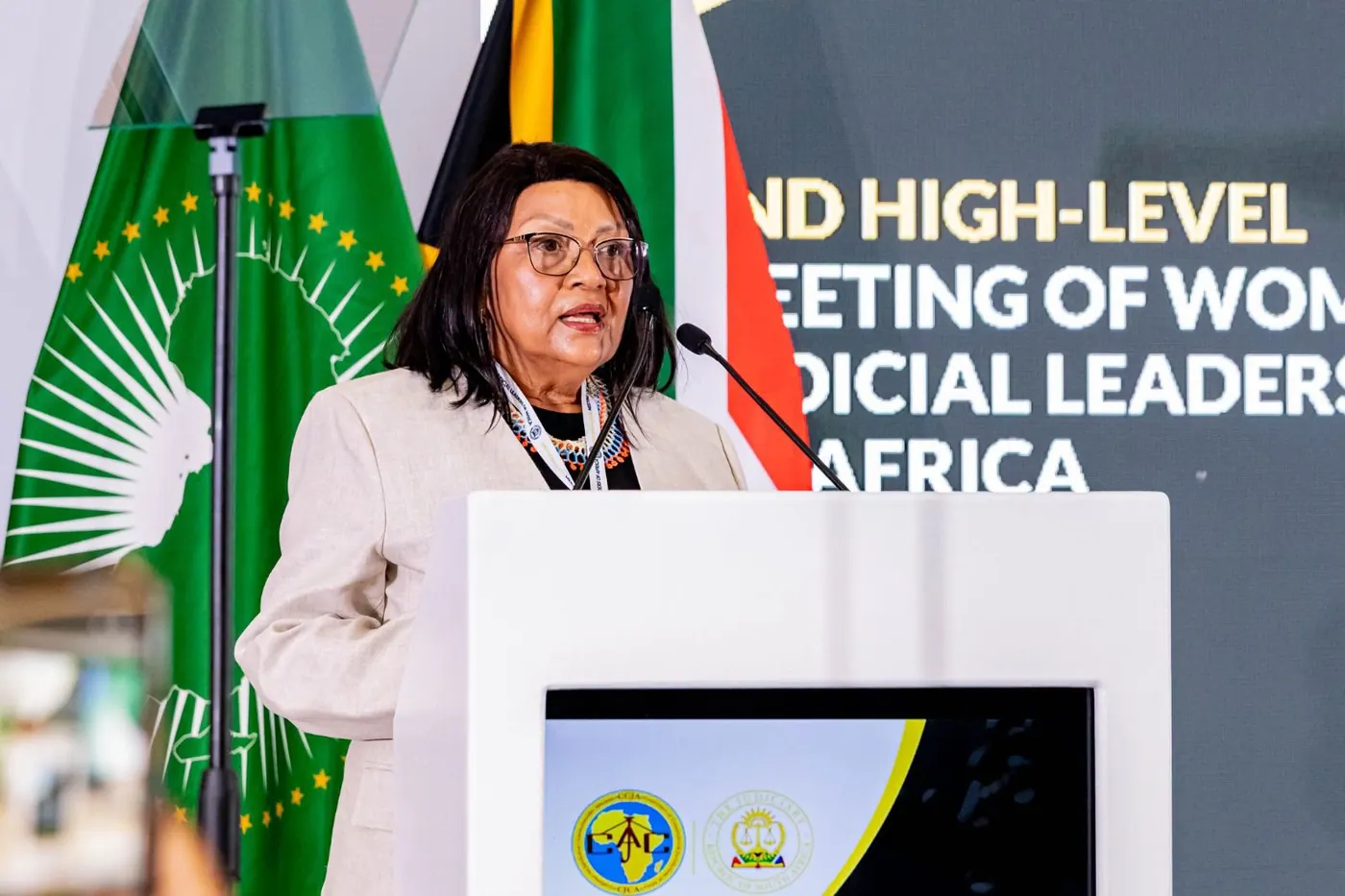
The 2nd High-Level Meeting of Women Leaders of Judicial Bodies in Africa has been under way since Monday, 20 April 2026, in Johannesburg, Republic of South Africa.
Representing the Republic of Angola, the Vice-President of the Constitutional Court, Justice Victória Izata, took part on the afternoon of Wednesday in the session on Economic Justice and the Empowerment of Women.
“A Protecção Jurisprudencial da Igualdade de Género em Angola: entre Práticas Costumeiras e a Efectividade dos Direitos da Mulher no Marco dos 20 Anos do Protocolo de Maputo” (The Jurisprudential Protection of Gender Equality in Angola: between Customary Practices and the Effectiveness of Women's Rights at the 20-Year Mark of the Maputo Protocol) was the topic presented by the Vice-President, who in this regard highlighted the central role of constitutional case law as an instrument of harmonisation, and also affirmed the supremacy of the Constitution and of the international human rights treaties ratified by Angola, including the Maputo Protocol, over customary practices incompatible with the principle of equality and the dignity of the human person.
Read in full the address by the Vice-President of the Constitutional Court
On behalf of and representing the Honourable President of the Constitutional Court of Angola, Dr Laurinda Prazeres, I wish to greet everyone, all the participants present, and to thank the distinguished and Honourable President of the Constitutional Court of South Africa, Dr Mandisa Maya, for the kind invitation extended to our Court to take part in this important Event, for the warm welcome and for the excellent working and hospitality conditions provided in this beautiful city of Johannesburg.
Dear Colleagues,
In taking the floor at this forum of singular relevance, I do so not only on behalf of the Constitutional Court of Angola, but also as a woman who, from one of the highest judicial bodies of an African State, witnesses, with legal and human sensitivity, the distance that sometimes still lies between the written norm and daily life.
The topic that brings us together — “The Jurisprudential Protection of Gender Equality in Angola: between Customary Practices and the Effectiveness of Women's Rights at the 20-Year Mark of the Maputo Protocol” — is not a mere academic reflection.
It is, above all, a question of constitutional justice.
It is a question of the dignity of the human person.
And it is, most of all, a question that directly challenges us as women of the African judiciary, placed on the front line of the interpretation and application of the Law.
In Angola, as in most African States, two normative systems that claim to regulate human relations coexist, with greater or lesser tension: on the one hand, formal State law, embodied in the Constitution and in ordinary legislation; on the other, customary law, built up over centuries of social practices, usages and community values.
This coexistence is, in itself, a source of richness.
But when it is not adequately mediated by the rule of law, it can become a source of structural inequality, which falls particularly heavily on women.
Allow me to present some data from the Angolan experience.
Angola has an estimated population of about 37.9 million inhabitants, of whom 50.52% are women, corresponding to approximately 19.1 million.
Of these, between 69% and 70% live in urban areas, and 30% to 31% in rural areas.
It should be noted that, in the urban context, a very significant proportion of these women live in the so-called musseques (informal settlements), areas marked by heightened socio-economic vulnerabilities.
In addition, 34.5% of households are headed by women, a percentage that rises in peri-urban areas.
The overall poverty rate stands at 41%, and women make up the majority of the poor population.
Your Excellencies,
It is in this context that the paradox arises of the woman who is the formal holder of assets left by the deceased (de cujus), yet has no effective access to them.
The Constitution of the Republic of Angola, adopted in 2010, expressly and unequivocally enshrines equality between men and women.
Article 23(1) establishes that all are equal before the law, and that no one may be privileged or disadvantaged on grounds of, inter alia, sex. Articles 23 and 35 ensure equality between spouses and guarantee the right to family and to marriage in full equality.
The norm exists.
It is clear.
It is binding.
And it sits at the apex of the legal order.
However, social reality shows that, in vast parts of the national territory, many women continue to see these rights become a dead letter when confronted with the force of discriminatory customary practices.
In the Angolan experience, this paradox manifests itself in three essential dimensions:
The first is personal autonomy.
Despite legal protection against forced and early marriage, there persist contexts in which young women remain subject to marriage arrangements decided by councils of elders, without their will being given any effective weight.
The data are eloquent: 30% of Angolan women aged between 20 and 24 were married before the age of 18, and 8% before the age of 15. More than 80% of these marriages are informal or customary unions, with only about 20% formally registered.
The second dimension is property.
A woman who, on the death of her husband, is legally entitled to inheritance rights frequently finds herself excluded from the inheritance by traditional practices of transferring property to the family of the deceased.
According to data from the Ministry of Social Action, Family and Promotion of Women, the Ministry of Territorial Administration and the Ministry of Youth and Sports, more than 40% of Angolan men own land; there are, however, no consolidated data on women's land ownership.
In the event of the death of one of the spouses, the law ensures that the surviving spouse, whether man or woman, holds 50% of the couple's common property where the marriage was entered into under the regime of community of acquired property, the surviving spouse also remaining in fourth place in the order of succession provided for in Article 2133 of the Civil Code.
Notwithstanding this legal framework, social practice shows that, both in formally constituted marriages and, more acutely, in de facto unions not legally recognised, the intervention of the relatives of the deceased in determining the fate of the estate tends to prevail, frequently to the detriment of the position of the surviving spouse.
At the economic level, only 22% of Angolan women have a bank account, compared with 36% of men, and only 14% of companies in Angola are headed by women.
The third dimension is that of violent dispossession, or property grabbing.
When a widow seeks to exercise the right that the law grants her, she is not infrequently confronted with the physical occupation of the property, the removal of movable goods and, in the most serious cases, forcible expulsion from the marital home, in addition to heavy psychological pressure upon her.
This constitutes a simultaneous violation of the right to property, the right to housing and the dignity of the human person.
Angola is among the countries of Sub-Saharan Africa where this practice remains prevalent.
In rural areas, experience shows that widows face systematically unfavourable customary decisions; in urban areas, even after a favourable court decision, practical obstacles to the recovery of property persist. Not infrequently, accusations of witchcraft arise as a mechanism for the social legitimisation of the expulsion.
The consequences also fall on the children: loss of access to education, health care and food.
Dear Colleagues, Your Excellencies,
The question of literacy is equally central.
The female literacy rate in Angola stands at between 62% and 66%, while the male rate ranges between 79% and 82%.
A woman who cannot read often has no access to the law that protects her.
But there are signs of hope: more than 50% of those enrolled in Faculties of Law are women, revealing a growing feminisation of legal education.
Significant shortfalls in civil registration nevertheless persist in the interior of the country, limiting the full operability of legal personality for procedural purposes.
It should, however, be stressed that the phenomenon of the dispossession of widows is not limited to contexts of low schooling or lack of knowledge of legally enshrined rights. Indeed, even in circles where individuals have a high level of academic education and a full command of the legal rules applicable to property rights and to succession, practices persist that result in the wrongful removal of the widow's property.
In these situations, the conduct of the relatives of the deceased does not stem from ignorance of the law, but rather from the influence of deeply rooted cultural and social patterns, frequently associated with customary law. The latter, by virtue of its normative force within communities, ends up overriding positive law, leading to the illegitimate appropriation of the estate to the detriment of the woman, who is, under the law, the legitimate holder of inheritance rights.
This reality highlights the existence of a tension between formal law and social practices, demonstrating that mere knowledge of the law is not, in itself, sufficient to guarantee its effectiveness. The prevalence of conduct contrary to the legal order reveals the need for a more comprehensive approach, which includes not only the rigorous application of the law by the courts but also the promotion of cultural and social change.
Accordingly, the protection of the rights of widows must be regarded as a priority, requiring joint efforts by the State, the judicial institutions and society to ensure respect for the right to property, for the dignity of the human person and for the principle of gender equality, regardless of the level of education of those involved.
The Angolan Constitution recognises customary law in Article 7, but only within the limits of the Constitution itself.
This is where the central point of the debate lies.
No customary practice can claim legal validity when it conflicts with the dignity of the human person, equality and non-discrimination.
The prevalence of the fundamental right over discriminatory custom is not an ideological choice.
It is a constitutional requirement.
But, Your Excellencies, prevailing in the norm is not the same as prevailing in life.
And it is precisely here that the role of the women who exercise leadership in the judiciary in Africa becomes decisive.
The Constitutional Court of Angola has been establishing firm case law rejecting custom as an instrument for eroding fundamental rights, including those of women.
But the courts cannot act alone.
The realisation of these rights requires coordinated action by the State in all its dimensions, and it requires of us, as women, especially those in leadership positions, historical awareness and a transformative commitment.
Every judgment that affirms equality.
Every order that rejects discrimination.
Every decision that restores to a woman effective access to the right she holds.
All of this is, at one and the same time, a judicial act and an act of historical justice.
Allow me to conclude with three commitments that I humbly propose to this forum:
* First, the commitment to an active constitutional interpretation that subjects customary practices to the scrutiny of fundamental rights.
* Second, the commitment to bring the courts closer to communities, through legal literacy, itinerant courts and mechanisms for free access to justice (and here allow me to say that the Constitutional Court in Angola has been a pioneer in going to the most remote regions of our country, holding meetings with communities to talk about the Constitution).
* Third, the commitment to active solidarity among the women of the African courts, through the sharing of case law, experience and institutional support networks, such as this High-Level Meeting.
The data I present here are not abstract numbers.
They are real lives.
They are widows expelled from their homes.
They are girls taken out of school.
They are women prevented from exercising rights that the Constitution grants them.
I bring from Luanda to Johannesburg a profound conviction:
Law that does not reach women in their real lives is incomplete Law.
And a judiciary that tolerates this incompleteness has not yet fully accomplished its constitutional mission.
To us, the women who lead this African judiciary, falls the honour — and the duty — of refusing to accept it.
Blessings to you all!
Thank you very much for your attention!