
Translated from Portuguese. The Portuguese version prevails. Ler em português
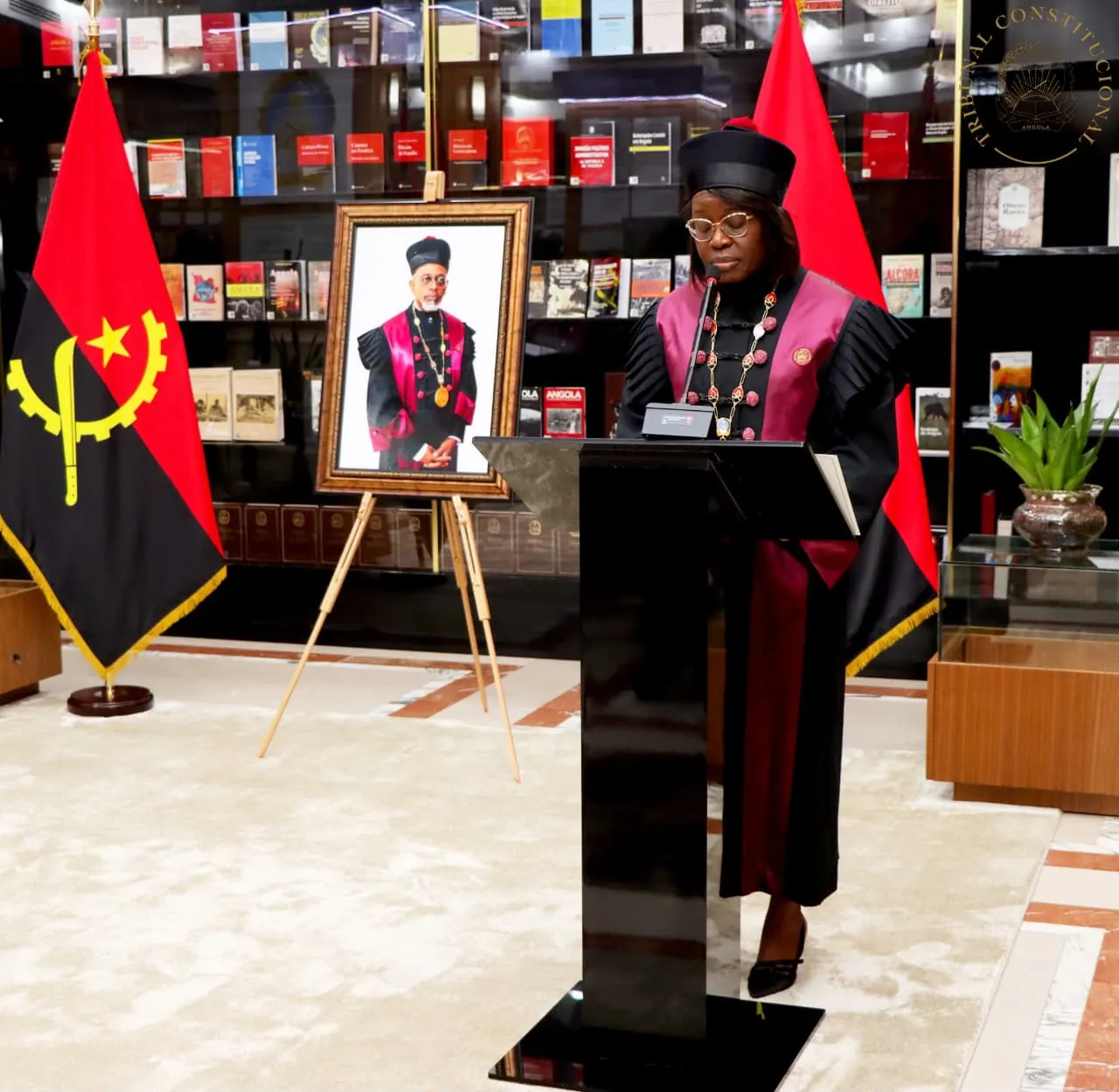
The address by the President of the Constitutional Court, Justice Laurinda Prazeres, at the ceremony in tribute to Justice Vitorino Hossi, in full.
Most Excellent bereaved family, Dear Colleagues, Distinguished Authorities, Ladies and Gentlemen.
We have lost Justice Vitorino Domingos Hossi. We lost him abruptly, without the warning that life sometimes has the kindness to grant. We were counting on him. We were still counting on him this week, and that is the rawest form of grief: not that of the one who departs, but that of the one who is left still counting.
His biography will say what is public: that he was Minister of Trade in the Government of Unity and National Reconciliation, when this country was trying, with hands still trembling, to learn peace. That his testimony was recorded among those who told, from the inside, the story of the road to Bicesse.
That he was a jurist and lawyer of solid training and of study never interrupted, that the National Assembly elected him, and that he took office at this Court in January 2023, where he served constitutional jurisdiction until his last day. In other words, the biography will not say what is essential.
What is essential is that Hossi was enough. There was a quality in him that no curriculum vitae records: he was present at every moment. On the great days and, above all, on the small days; despite the care that his health called for, the state of the national roads did not deter him from travelling by road – Luanda/Porto Amboim/Benguela/Lubango/Gambos – to be present at our Ondjango da Constituição (community forum on the Constitution). He was always present, at the joyful occasions that bring crowds together and at the most restricted events. He was one of those who would call for no reason, one of those who would ask the names of our children and then remember them. The word that best defined him was not any office. It was presence.
And there was, too, his passion for books. In them he found knowledge, reflection and, certainly, part of that silence which so characterised him.
Justice Hossi believed that a people that does not publish its authors slowly fades away without noticing. He supported works that were not his own. He gave a name, the means and courage to those who had a manuscript and no open doors. He was a patron in the old and noble sense of the word: one who finances beauty without demanding that it belong to him. Allow me, at this point, a note that is not a legal one. The science that today studies grief teaches us something at once disturbing and consoling. When we live alongside someone for a long time, our brain builds a map of that person. A map that places them permanently in the category of those who are here, who are near and who always will be. That map is not erased by the news. It remains. That is precisely why it hurts so much: a part of us goes on waiting for him. It goes on hearing his footsteps in the corridor. It goes on preparing the answer to a question he will no longer ask.
But if we understand this same science properly, it tells us something else. Human memory is not an archive in which the dead are filed away. It is reconstruction. Each time we recall him, we make him exist again. And Justice Hossi was not stored in a single place; he is distributed. He is in the gesture of solidarity that we learned from him and repeat without realising;
He is in the phrases he used to say and which we have already said to others as if they were our own – I myself can no longer rid myself of his subtle “oh Caramba”. He is in each one of us who today holds one or dozens of the books he made a point of giving, regularly.
His time at the Constitutional Court was brief, but it was not small. He left a mark here; a mark made of cordiality, of respect, of culture and of a discreet presence which, perhaps for that very reason, we feel all the more today.
He also left us a powerful lesson: that collegiality is not unanimity, and that serving the Constitution sometimes requires the serene courage to stand alone. He did not fear, when his conscience compelled him, the solitude of a dissenting vote. That is the respect owed to a Court: to disagree within it, with loyalty and without fanfare.
To his family, to the Staff of his Office, to those whose homes are silent today: weep. The magnitude of the grief is simply the exact measure of the space he occupied. I ask you, however, to speak of him – speak of him, and speak of him a great deal. Out loud and unhurriedly. For it is by speaking of our dead that we keep their memory alive.
And it is beyond dispute that Justice Hossi left a memory. The person has departed, but the legacy remains.
It remains in his peers, the Justices, with whom he shared the exercise of judicial office; he left it in the staff of this House, with whom he worked side by side; and it remains, above all, in those who had the privilege of knowing him more closely.
Today, as we look back, we realise that we had the privilege of having him among us for a brief period, but one long enough for his presence to become part of our institutional and human memory.
That is perhaps the greatest mark anyone can leave: to be remembered not only for what they did, but for the way in which they made others feel their presence.
And we felt it, Justice Vitorino Domingos Hossi: As long as a single person who dealt with you still breathes, you will not have died. And we are many. May your Soul Rest in peace.
Thank you very much.